


Engineers often encounter a frustrating paradox when designing high-performance transparent components. Polycarbonate is the "iron man" of the plastic world—virtually unbreakable, heat-resistant, and incredibly tough. Yet, once it undergoes the rigors of a milling or turning cycle, its most valuable asset—transparency—vanishes. What was once a clear block of engineered resin becomes a milky, opaque object covered in a landscape of microscopic tool marks. This haze is not just a cosmetic flaw; it is an optical failure that scatters light and obscures internal features.

Restoring this clarity to a professional standard requires more than just sandpaper and buffing wheels. While mechanical polishing works for flat, accessible surfaces, it fails in the complex internal channels of a medical manifold or the aggressive curves of an automotive light pipe. This technical vacuum is filled by a specialized process known as Vapor Polishing Polycarbonate. It is a form of chemical "alchemy" that melts the surface at a molecular level, allowing physics to smooth out the imperfections that no hand tool could reach. At Jucheng Precision, we have integrated this advanced finishing technology into our CNC Polycarbonate Machining workflow to deliver parts that meet the optical demands of the aerospace and healthcare industries.
Choosing vapor polishing is an investment in both aesthetics and functionality. For a designer, it represents the ability to see inside a working assembly or to pipe LED light with surgical precision. This guide explores the deep mechanics of the vapor polishing cycle, the chemistry of surface tension, and the rigorous safety protocols JUCHENG employs to ensure every transparent component is as clear as the vision that created it. Achieving this level of "water-white" clarity requires a mastery of both the machine and the molecule.
Opaque Reality: The Problem with Machined PC
Chemical Alchemy: How Vapor Smoothing Works
Reaching the Unreachable: Deep Bores and Channels
Safety First: Managing Hazardous Chemistry
Automotive Lighting: The Ultimate Performance Test
JUCHENG’s Integrated Finishing Assurance
Opaque Reality: The Problem with Machined PC
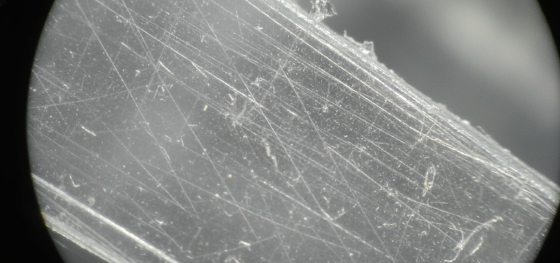
To understand the value of Vapor Polishing Polycarbonate, one must first look at the surface of a part directly off the CNC mill. Even with the sharpest diamond-like carbon (DLC) coated tools and the highest spindle speeds, the cutting process is a series of microscopic fractures. Every time the flute of an end mill strikes the plastic, it leaves a ridge. These ridges are often only a few microns tall, but they are larger than the wavelength of visible light. When light hits these ridges, it doesn't pass through; it bounces around in a thousand different directions. This is light scattering, and it is the reason why machined polycarbonate looks "frosted."
Furthermore, the heat generated during CNC Polycarbonate Machining can induce localized stresses on the skin of the part. If you try to fix this haze with a traditional buffing wheel, you run a high risk of "smearing" the surface. The friction of the buffing cloth can easily exceed the glass transition temperature of the PC, leading to a distorted, wavy finish known in the industry as "orange peel." For components that require true optical fidelity—such as sensor covers or camera housings—standard mechanical methods are simply too crude. We need a way to level the surface without touching it with a physical abrasive. This need for a non-contact leveling system is the primary driver behind the adoption of vapor-phase finishing.
Chemical Alchemy: How Vapor Smoothing Works

The physics of vapor polishing is elegant in its simplicity but brutal in its requirements for control. The process involves exposing the Polycarbonate component to a pressurized vapor of a solvent, typically Methylene Chloride (Dichloromethane). Unlike a liquid dip, which would aggressively melt and distort the entire part, the gas phase allows for a much more subtle and uniform interaction. When the cool PC part is introduced to the warm solvent vapor, the gas condenses on the surface, creating an incredibly thin, liquid-like film of solvent-saturated polymer.
In this momentary semi-liquid state, surface tension becomes the primary architect. Much like a raindrop pulls itself into a perfect sphere, the liquid surface of the plastic pulls itself flat. It naturally flows from the "peaks" of the tool marks into the "valleys." Once the part is removed from the vapor, the solvent evaporates instantly, re-solidifying the plastic into a surface that is as smooth as a mirror. At Jucheng Precision, the secret to success is the "Soak Time." If the exposure is too short, the haze remains. If it is too long, the solvent will penetrate too deeply, compromising the dimensional accuracy of the part or causing it to "frost" over. Our technicians calibrate these exposure times down to the second, based on the specific grade of PC and the ambient humidity of our finishing lab.
Reaching the Unreachable: Deep Bores and Channels
While mechanical buffing is excellent for external surfaces, it is useless for the internal architecture of a part. Imagine a medical manifold used for blood analysis. It might have a complex web of intersecting 2mm bores that must be optically clear so that sensors can detect bubbles or particulate matter. There is no buffing tool small enough or flexible enough to reach inside those channels. This is where Vapor Polishing Polycarbonate becomes a mandatory engineering requirement.
Because the solvent exists in a gaseous state, it behaves like any other gas—it expands to fill the entire volume of its container. It flows through the most intricate internal threads, around sharp corners, and deep into blind holes. It treats the inside of a part with the same precision as the outside. This uniformity is vital for light pipes and optical guides. If the internal entrance of a light guide is hazy, it will lose 30% of its efficiency before the light even enters the part. By vapor polishing the entire manifold or light pipe, JUCHENG ensures a seamless optical path from entry to exit, a feat that sets our CNC Polycarbonate Machining apart from general-purpose plastic shops.
Safety First: Managing Hazardous Chemistry
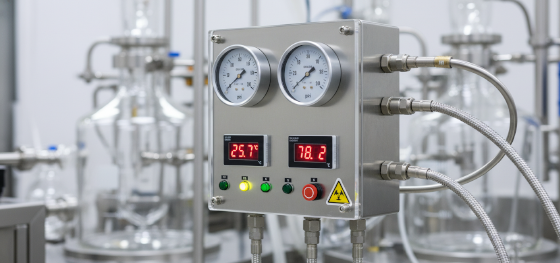
We must be transparent with our clients: vapor polishing involves hazardous chemicals. Dichloromethane is a restricted substance that requires a sophisticated infrastructure to handle safely. This is the reason why many small shops refuse to offer this service. You cannot simply boil solvent in a beaker; you need a closed-loop, environmentally controlled system. At Jucheng Precision, safety is not an afterthought; it is a primary manufacturing parameter.
Our vapor polishing facility is equipped with high-volume air filtration and solvent recovery systems. We ensure that zero chemical residue remains on the parts before they are packaged. Furthermore, we recognize that the chemical reaction of polishing can introduce internal stresses—a phenomenon called "crazing" if the part is later exposed to alcohol. To prevent this, JUCHENG implements a mandatory post-polish annealing cycle for critical parts. By slowly heating the polished parts in a controlled oven, we allow the molecules to relax, locking in the clarity and ensuring that the part doesn't develop spiderweb cracks months after it is installed in the field. This commitment to the long-term lifecycle of the material is what defines a professional manufacturer.
Automotive Lighting: The Ultimate Performance Test

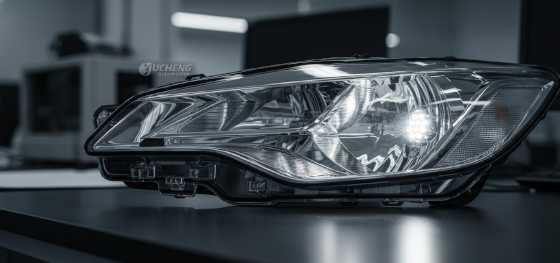
The most demanding application for Vapor Polishing Polycarbonate is the automotive lighting sector. Modern luxury vehicles utilize complex, thick-walled lenses and intricate light guides that carry LED signals across the dashboard. These parts must be 100% clear. Any internal haze or surface ripple will cause "light leakage," ruining the uniform glow that automotive designers obsess over. When a Tier-1 supplier needs to verify a headlight design, they cannot wait six weeks for an injection mold. They need a functional prototype in days.
Jucheng Precision specializes in these "impossible" prototypes. We combine 5-axis CNC Polycarbonate Machining with a hybrid polishing strategy. We may manually buff the large, external primary surfaces to achieve a mirror finish, then utilize vapor polishing to "clear out" the tiny mounting tabs and internal facets that the buffing wheel cannot reach. This dual-action finishing ensures that the prototype performs exactly like the final molded part on a light bench. Our ability to provide this level of optical fidelity is why we are the preferred partner for innovative lighting brands who need their prototypes to shine with production-level quality.
JUCHENG’s Integrated Finishing Assurance
Choosing a manufacturer for clear plastic parts is a decision of trust. If you buy machining from one vendor and finishing from another, you create a gap in accountability. If the part warps or the clarity is poor, who is responsible? Jucheng Precision eliminates this risk by owning the entire value chain. We don't just "outsource" our polishing; we treat it as an integral part of the machining cycle.
Our quality control team utilizes high-intensity inspection lamps and light transmission meters to verify that your parts meet the required transparency percentage. We handle finished components with lint-free silk gloves and use specialized anti-static packaging to ensure that the "water-clear" finish we achieve in our lab survives the journey to your facility. Whether you are developing a revolutionary medical diagnostic tool or a high-end consumer display, JUCHENG has the technical rigor and the chemical expertise to bring your designs into the light. Don't let a hazy finish diminish the brilliance of your engineering. Contact Jucheng Precision today for a professional consultation and experience the clarity that only expert vapor polishing can provide.

