


Should your material dictate your design? Or should your design command your material? This is a fundamental question every great designer must answer.
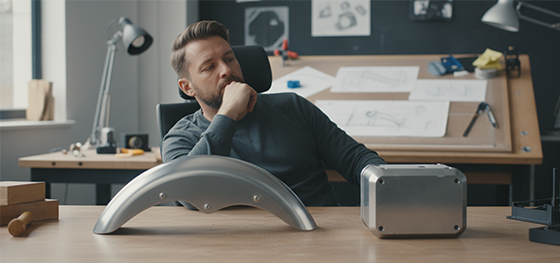
In the world of aluminum alloys, this question is perfectly embodied in a classic showdown. It is a battle between two very different philosophies, two very different personalities.
This is the contest of 5052 aluminum vs 6061. It is a choice between a material that loves to be formed, and a material that loves to hold its form. Choosing the right one is key to your project's success.
content:
Meet the Artist: 5052 Aluminum
Meet the Engineer: 6061 Aluminum
Head-to-Head: A Table of Truth
Making the Right Call
Meet the Artist: 5052 Aluminum

5052 aluminum is the artist of the alloy world. Its personality is soft, ductile, and willing to be shaped. Its primary superpower is its excellent formability.
It can be bent into tight radii, stretched, and formed into complex curves without cracking. This is because it is a non-heat-treatable, work-hardening alloy. Its main alloying ingredient is magnesium, which gives it this wonderful ductility.
This makes 5052 the undisputed king of sheet metal fabrication. If your design involves creating a flowing, organic shape from a flat sheet—like a custom motorcycle fuel tank or a marine hardware component—5052 is your go-to material. It also has the best corrosion resistance of all common non-heat-treatable alloys, making it perfect for those marine applications.
Meet the Engineer: 6061 Aluminum
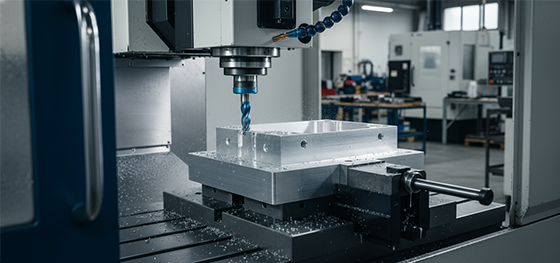
If 5052 is the artist, then 6061 aluminum is the engineer. Its personality is strong, reliable, and structural. Its primary superpower is its excellent strength-to-weight ratio.
6061 is a heat-treatable alloy. This means after it is formed, it can be put through a heating and aging process (creating the T6 temper) that significantly increases its strength. It is much stronger and harder than 5052.
This makes it the champion of machined structural components. When you need to create a rigid, load-bearing part like a robot arm, a machine baseplate, or a bicycle frame, 6061 is the superior choice. It is also one of the most versatile cnc machining aluminum alloys, offering a great balance of machinability, weldability, and corrosion resistance.
Head-to-Head: A Table of Truth
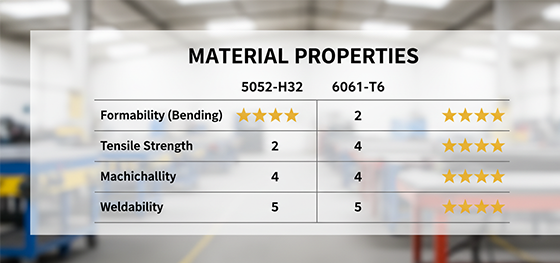
Let's put the two side-by-side to see their differences clearly.
| Property | 5052-H32 Aluminum ("The Artist") | 6061-T6 Aluminum ("The Engineer") |
|---|---|---|
| Superpower | Excellent Formability | Excellent Strength-to-Weight |
| Tensile Strength | Fair (~228 MPa) | Good (~310 MPa) |
| Primary Use | Sheet Metal Fabrication | CNC Machining |
| Weldability | Excellent | Excellent |
| Marine Corrosion Resistance | Excellent | Good |
Making the Right Call

The choice in the 5052 aluminum vs 6061 debate is a choice of priority.
You must ask: what is the primary job of my part?
If the answer involves bending, forming, or creating a shape from a flat sheet, 5052 is almost always the correct answer. Its willingness to be shaped is its defining characteristic. It is also the better choice for parts that will live in a saltwater environment.
If the answer involves bearing a significant load, resisting flex, or being machined into a precise structural component from a solid block, then 6061 is the superior choice. Its strength and rigidity are its defining purpose.
A true manufacturing partner understands this distinction. At JUCHENG, we are experts in both sheet metal fabrication and CNC machining. This allows us to provide you with unbiased, expert advice. We can look at your design and help you choose the material that is not just a material, but a true partner for your specific design philosophy.

