


In mechanical design, there is a silent killer. It is not the single, massive impact that you can simulate in software. It is the millions of tiny, repetitive stresses that a part endures over its lifetime. It is vibration. It is pressurization cycles. It is called fatigue.
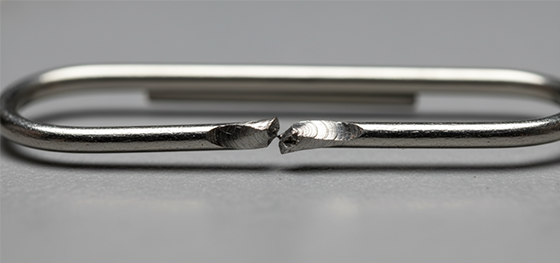
Fatigue can cause a part that seems perfectly strong to suddenly fail without warning. To fight this invisible enemy, engineers turn to a classic, battle-tested warrior in the world of aerospace alloys.
This is the world of 2024 aluminum. The process of aluminum 2024 machining is about shaping a material that is specifically designed to endure a lifetime of stress and keep fighting.
content:
Fighting Fatigue: Introducing 2024 Aluminum
A Machinist's View on a Worthy Opponent
Facing its Achilles' Heel: Corrosion
Making a Strategic Choice: 2024 vs. 7075
Fighting Fatigue: Introducing 2024 Aluminum
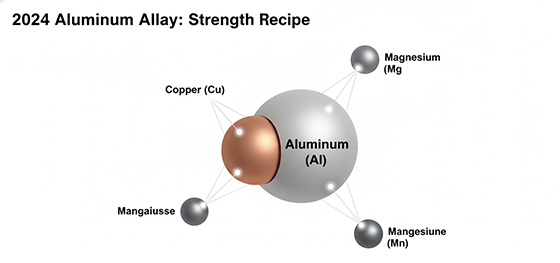
2024 is one of the most famous of all high-strength CNC machining materials. It is a true aerospace workhorse. Its secret weapon is its primary alloying element: copper.
The addition of copper, combined with a precise heat treatment (usually to a T3 or T4 temper), gives 2024 aluminum two key properties. First, it has very high strength, approaching that of the even stronger 7075 alloy.
But its real superpower, its claim to fame, is its excellent fatigue resistance. This means it can withstand repeated cycles of being loaded and unloaded without developing microscopic cracks. This is why it has been the go-to material for aircraft fuselages and wing structures for decades. These components are constantly flexing and vibrating during flight. 2024 is designed to endure this punishment for the entire life of the aircraft.
A Machinist's View on a Worthy Opponent
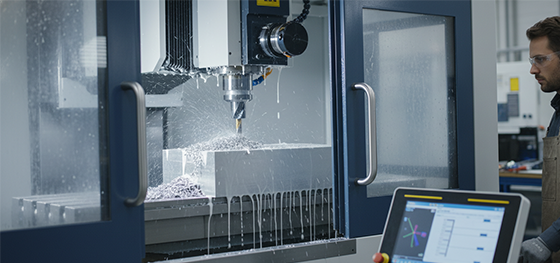
This high strength also means that aluminum 2024 machining presents a greater challenge than working with a standard alloy like 6061.
It is a harder and more abrasive material. It puts more stress on the cutting tools and causes them to wear faster. A machinist cannot use the same aggressive, high-speed parameters they would use on 6061.
Instead, they must adopt a more controlled approach. This typically involves using a lower spindle speed, a more moderate feed rate, and ensuring a constant flood of high-quality coolant to manage heat and clear chips.
While it is more demanding than 6061, it is generally considered to have better machinability than the even harder 7075 alloy. It produces good surface finishes and can be machined to very tight tolerances by a skilled manufacturer.
Facing its Achilles' Heel: Corrosion
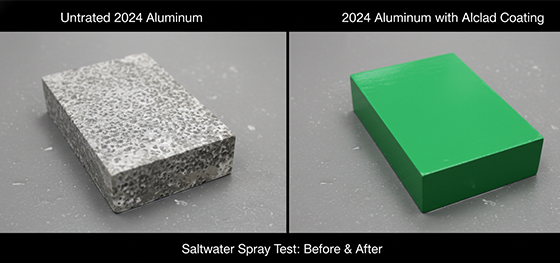
The copper that gives 2024 its strength is also the source of its greatest weakness. It has relatively poor corrosion resistance.
When exposed to moisture, especially in a saltwater environment, a bare 2024 aluminum part will corrode much more quickly than an alloy like 6061. This is a critical trade-off that every designer must account for.
To solve this problem, 2024 is almost always used with a protective surface layer. In the aerospace industry, it is very common to use a product called "Alclad." This is a sheet of 2024 aluminum that has a very thin layer of high-purity aluminum metallurgically bonded to its surface. This pure aluminum layer acts as a sacrificial coating, providing excellent corrosion protection for the strong 2024 core.
For machined parts, a chemical conversion coating and/or a durable paint or powder coat is essential.
Making a Strategic Choice: 2024 vs. 7075
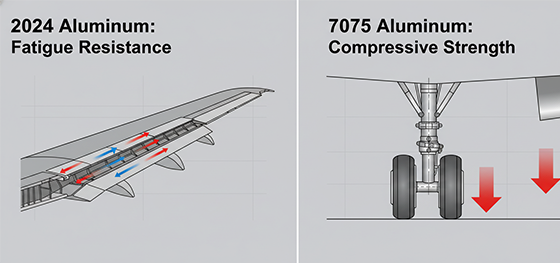
Both 2024 and 7075 are high-strength aerospace alloys. How does a designer choose between them? It comes down to understanding their different superpowers.
You choose 2024 aluminum vs 7075 when your primary concern is fatigue resistance. If your part will be subjected to many cycles of tension and bending, like an aircraft wing skin, 2024 is the superior choice. It is more damage-tolerant.
You choose 7075 when your primary concern is absolute tensile strength. If your part is primarily under a constant, high-stress pulling or compressive load, like a landing gear component, the higher strength of 7075 makes it the winner.
| Property | Aluminum 2024-T3 | Aluminum 7075-T6 |
|---|---|---|
| Primary Alloying Element | Copper (Cu) | Zinc (Zn) |
| Yield Strength | ~324 MPa (Very Good) | ~503 MPa (Excellent) |
| Key Superpower | Excellent Fatigue Resistance | Highest Strength |
| Corrosion Resistance | Poor | Fair |
Understanding this strategic difference is the mark of an experienced aerospace designer. At JUCHENG, our expertise in machining both of these demanding alloys allows us to be your trusted partner, no matter which high-performance path your project requires.

