


In the world of aluminum alloys, there is a classic title fight. In one corner, the challenger: a versatile, reliable, and cost-effective champion loved by all. In the other corner, the reigning king: a high-strength, aerospace-grade powerhouse that commands a premium price.
This is the ultimate showdown: 6061 aluminum vs 7075 aluminum.

For an engineer, choosing between these two titans is one of the most common and critical decisions in product design. There is no single right answer. The winner depends entirely on the rules of your specific fight. This guide is your ringside seat to the battle.
content:
Round 1: The Tale of the Tape - Raw Strength
Round 2: The Fight in the Ring - Machinability
Round 3: The Clinch - Weldability
Round 4: The Price of Power - Cost
Choosing Your Winner
Round 1: The Tale of the Tape - Raw Strength

In a pure test of strength, there is a clear winner. 7075-T6 aluminum is one of the strongest aluminum alloys commercially available. Its yield strength is nearly double that of 6061-T6. It is comparable to many common steels.
This immense strength comes from its primary alloying element, zinc. It makes 7075 the undisputed champion for applications where a part is under extreme tensile or compressive stress, and failure is not an option. Think of a critical structural component on an aircraft wing.
6061, with its magnesium and silicon recipe, is no weakling. It is more than strong enough for a vast range of applications, from electronic enclosures to bicycle frames. But in a head-to-head strength competition, it cannot compete with the sheer power of 7075.
Winner of this round: 7075 Aluminum.
Round 2: The Fight in the Ring - Machinability

Strength in the final part often means difficulty in the factory. When it comes to the ease of cnc machining aluminum, the tables are turned.
6061 is a machinist's favorite. It is relatively soft and cuts cleanly. It allows for very high machining speeds and produces predictable chips. This means parts can be made faster and with less tool wear, which translates to a lower cost.
7075 is a much tougher opponent. Its higher hardness and strength mean it fights back against the cutting tool. A machinist must use slower speeds, more moderate feed rates, and a more careful strategy to avoid tool wear and ensure a good finish. It is still much easier to machine than steel, but it is a more demanding and time-consuming process than working with 6061.
Winner of this round: 6061 Aluminum.
Round 3: The Clinch - Weldability
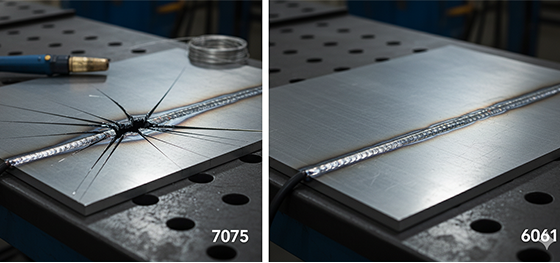
This round is not a fair fight. It is a knockout.
6061 aluminum has excellent weldability. It can be easily and reliably joined using standard welding techniques like TIG and MIG. This makes it the perfect choice for creating complex fabricated assemblies, like a custom chassis or frame.
7075 aluminum, on the other hand, is considered virtually unweldable for most structural applications. The high zinc content that gives it its strength also makes it very prone to cracking during the welding and cooling process. It is a material designed to be used as a monolithic, single piece.
Winner of this round: 6061 Aluminum, by a landslide.
Round 4: The Price of Power - Cost

High performance almost always comes at a high price. This fight is no exception.
The raw material cost of 7075 aluminum is significantly higher than 6061. This is due to its more complex alloying recipe and processing.
On top of that, the slower and more demanding machining process for 7075 adds to the final part cost. The combination of higher material cost and longer machine time makes a finished 7075 part considerably more expensive than an identical part made from 6061.
Winner of this round: 6061 Aluminum.
Choosing Your Winner

After four rounds, the scorecard seems to favor 6061. But this is not about which material wins the most rounds. It is about which material wins the round that matters most to you.
You must ask yourself: What is the primary mission of my part?
If your mission requires the absolute highest strength-to-weight ratio, and your part is a single, machined component that will be protected from corrosion, then 7075 is your champion. The higher cost is a necessary investment in performance.
But for almost every other mission—if your part requires a balance of good strength, weldability, corrosion resistance, and a reasonable cost—then 6061 is the smarter, more versatile champion.
A good manufacturing partner understands this strategic choice. At JUCHENG, our DFM process is not just about manufacturability. It is a consultation. We help you analyze the real-world demands of your project and choose the alloy that gives you the win where it counts.

