


When a component comes directly off a CNC mill, it is often a ghost of its final self. For transparent polymers, the machining process is a brutal necessity that leaves behind a wake of destruction at the microscopic level. The sharp edges of a carbide tool, no matter how precise, create a landscape of ridges and valleys that scatter light in every direction. This scattering is what we perceive as a milky haze or a frosted texture. For an engineer designing a high-end medical device or an automotive lens, this "machined finish" is a failure.
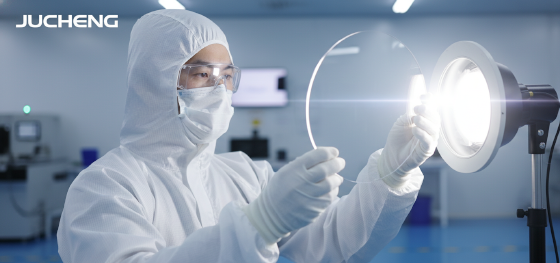
The transformation from this opaque state to a window-clear finish is the domain of Acrylic polishing. It is perhaps the most misunderstood phase of acrylic cnc machining. Many view it as a simple cosmetic touch-up, but in the world of high-precision optics, it is a critical manufacturing step that determines the light transmission efficiency of the entire system. At Jucheng Precision, we don't just "clean up" the part; we meticulously manipulate the surface molecules of the PMMA to eliminate the peaks and valleys, allowing light to pass through without resistance.
Achieving true optical clarity is a multi-stage battle against friction and heat. If you move too fast, the plastic melts and creates a distorted "orange peel" effect. If you skip a step, a single deep scratch from an earlier grit will haunt the final product, visible only under the harsh glare of a quality control light. This guide dives into the four primary pillars of professional finishing used at JUCHENG to turn raw machined plastic into crystal-clear engineering masterpieces.
content:
The Sanding Foundation: Pre-Polishing Rigor
Mechanical Buffing: High-Gloss Surface Restoration
Flame Polishing: Fast Edges and Thermal Risks
Vapor Polishing: The Gold Standard for Intricate Clarity
Automotive Lighting: Light Pipes and Clear Lenses
JUCHENG's Optical Commitment: Quality and Safety
The Sanding Foundation: Pre-Polishing Rigor
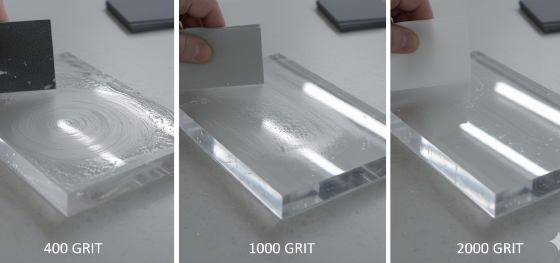
A common mistake in manufacturing is trying to polish a surface that hasn't been properly prepared. You cannot simply jump from a CNC tool mark to a high-speed buffing wheel. The foundation of successful Acrylic polishing is a rigorous sanding progression. At Jucheng Precision, we start by analyzing the tool path depth. If the machining was aggressive, we begin with a 400-grit wet sandpaper. The water is essential; it acts as a lubricant and carries away the plastic dust that would otherwise clog the paper and create new, deeper scratches.
We move through a disciplined ladder of grits: 400, 600, 800, 1200, and finally 2000. Each subsequent step must completely erase the scratch pattern of the previous stage. Our technicians use a cross-hatch technique, changing the direction of the sanding with each grit change. This makes it instantly obvious if a stubborn scratch from a lower grit remains. By the time the part reaches the 2000-grit stage, it should no longer be white or opaque; it should be a smooth, semi-transparent satin. This mechanical leveling is the most labor-intensive part of the process, but skipping it is the primary reason parts fail final inspection. You can buff a poorly sanded part until it shines, but you will still see the "ghosts" of the tool marks beneath the surface.
Mechanical Buffing: High-Gloss Surface Restoration
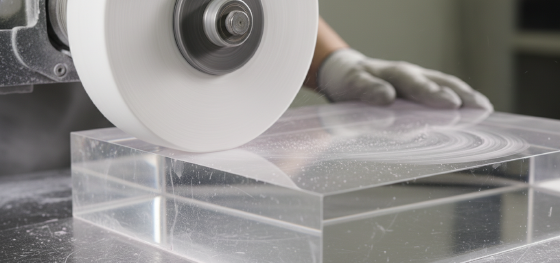
Once the surface is uniform and fine-grained, we move to mechanical buffing. This stage uses large, soft cloth wheels spinning at high speeds, combined with specialized abrasive compounds. The goal here is to remove the microscopic 2000-grit scratches and bring back the material's natural gloss. This is a game of temperature control. Acrylic is a thermoplastic, meaning it softens with heat. The friction of a high-speed buffing wheel can easily cross the line from "polishing" to "melting."
JUCHENG technicians use a "light touch and constant motion" strategy. If the wheel stays in one spot for more than a second, the plastic will overheat, causing a hazy smear that is nearly impossible to fix. We utilize specific compounds for acrylic that are designed to break down into even finer particles as they are used, essentially self-refining the polish as the process nears completion. This method is excellent for external surfaces and large, flat areas. It results in a "deep" shine that makes the part look like it was cast as a single solid piece of glass. For the consumer electronics and appliance industries, this mechanical buffing is the standard for visible exterior components.
Flame Polishing: Fast Edges and Thermal Risks

When speed is the priority and the geometry is simple—such as a straight edge on a display panel—flame polishing is a viable industrial solution. This technique uses a high-temperature hydrogen-oxygen flame to quickly melt the very top layer of the acrylic. As the plastic melts, surface tension pulls it flat, and as it cools, it hardens into a clear, glossy finish. It is visually impressive and incredibly fast.
However, Jucheng Precision provides a warning with this method. Flame polishing introduces significant internal thermal stress. The outer skin is heated and cooled rapidly while the core of the part remains stable. This creates a tension that can lead to "crazing"—thousands of tiny hairline cracks—later in the part's life, especially if it is cleaned with alcohol or exposed to varying temperatures. We typically reserve flame polishing for decorative items or simple signage where structural integrity and extreme longevity are secondary to initial cost and speed. For functional engineering parts, we generally recommend more stable methods.
Vapor Polishing: The Gold Standard for Intricate Clarity

This is where Acrylic polishing enters the realm of "high-tech" manufacturing. For parts with complex internal channels, tiny holes, or intricate 3D surfaces that a buffing wheel cannot reach, vapor polishing is the only answer. The process involves exposing the acrylic component to a chemical vapor, typically methylene chloride. This gas reacts with the surface of the PMMA on contact, melting the outer few microns of the plastic into a liquid state. Because it is a gas, it flows into every nook and cranny, achieving a uniform level of clarity that is impossible by hand.
At Jucheng Precision, vapor polishing is a controlled, high-stakes operation. The chemicals used are hazardous and must be handled in a specialized, airtight chamber with sophisticated ventilation. The timing is critical; exposure for even a few seconds too long will cause the part to "frost" or lose its dimensional accuracy. When done correctly, the result is a part that is optically perfect, even inside deep, narrow bores. This is the gold standard for medical manifold blocks where fluid flow must be visually monitored, and for high-end light guides where any internal haze would diminish the optical performance of the device.
Automotive Lighting: Light Pipes and Clear Lenses
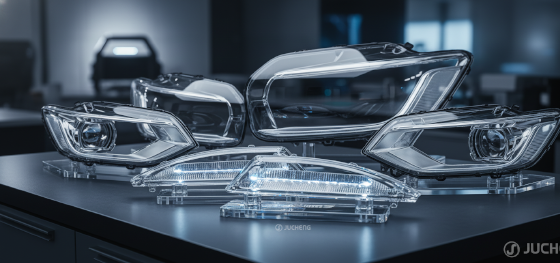
Nowhere is the demand for perfect transparency higher than in the automotive lighting sector. Modern luxury vehicles utilize intricate "light pipes"—long, slender acrylic rods that carry LED light across the dashboard or through the headlight assembly. Any flaw in the polish along the length of that pipe will cause a "leak" of light, creating a bright spot that ruins the uniform glow the designers worked so hard to achieve.
Jucheng Precision specializes in creating these automotive prototypes. We often combine our 5-axis machining with a hybrid polishing strategy. We may mechanically buff the main exterior lens surfaces for a glass-like shine, then use vapor polishing to clear the internal mounting features and tiny apertures. This ensures that the prototype performs exactly like the final injection-molded production part during light-bench testing. Our ability to provide this level of optical fidelity is why we are a trusted partner for Tier 1 automotive suppliers who cannot afford to wait weeks for a mold to see their lighting designs in action.
JUCHENG's Optical Commitment: Quality and Safety
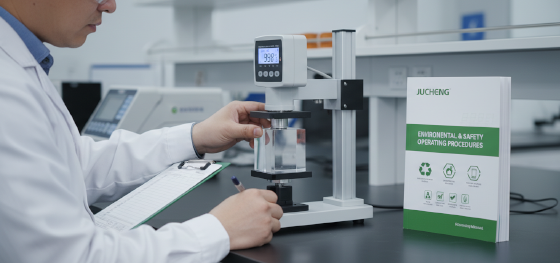
Achieving clarity is a science, but preserving it is a discipline. At Jucheng Precision, the polishing process ends with a rigorous quality control check. We use high-intensity inspection lamps to look for sub-surface fractures, and we utilize light transmission meters to verify that the part meets the required percentage of transparency. Furthermore, we understand that acrylic parts are sensitive. After the final polish, parts are handled only with lint-free silk gloves and are immediately protected with anti-static films or vacuum packaging to prevent any scratches during transit.
Our commitment also extends to environmental safety. Professional finishing, especially vapor polishing, requires a serious infrastructure to protect the technicians and the environment from chemical exposure. When you partner with JUCHENG, you are working with a facility that takes these responsibilities as seriously as the tolerances on your print. We provide a seamless transition from the rough cut to the final, optical-grade shine, giving your transparent designs the clarity they deserve. Don't let a hazy finish diminish the value of your precision engineering. Contact Jucheng Precision today to see the difference that expert finishing can make for your next project.

