


Imagine looking through a piece of solid plastic and seeing the same clarity you would expect from a high-end glass lens. This is the promise of acrylic, also known as PMMA. It is a material that defines modern aesthetics in everything from medical manifolds to automotive light pipes. But for a machinist, that beauty is a trap. Acrylic is notoriously temperamental. One wrong move and a crystal-clear block turns into a shattered mess of white cracks, or worse, a melted glob of plastic fused to your expensive cutting tool.
Achieving perfection in acrylic cnc machining is an exercise in heat management and vibration control. Unlike metals, which can dissipate heat through the chip, acrylic acts as an insulator. It holds onto the thermal energy generated by the friction of the cut. If that heat crosses a specific threshold, the material reaches its glass transition temperature and begins to revert to a gummy liquid. At Jucheng Precision, we have spent years refining our processes to prevent these common failures, ensuring every edge is as sharp as the design intends.
This guide is designed to strip away the guesswork. Whether you are struggling with edge chipping or surface haze, we will dive deep into the technical nuances of cnc acrylic cutting. From the geometry of the flute to the physics of the chip load, understanding these variables is the difference between a part that looks like industrial scrap and one that shines with optical clarity.
content:
Router or Mill: Matching Machine to Scale
Tool Selection: Magic of the O-Flute
Up-cut vs Down-cut: Directing the Flow
Speeds and Feeds: Mastering the Cool Cut
Workholding: Stability Without Damage
Router or Mill: Matching Machine to Scale
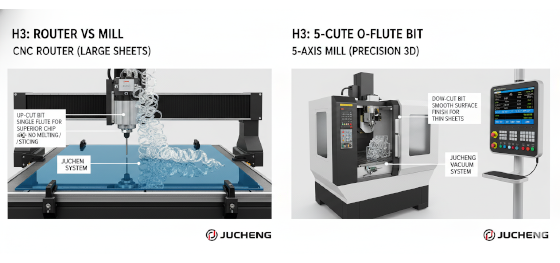
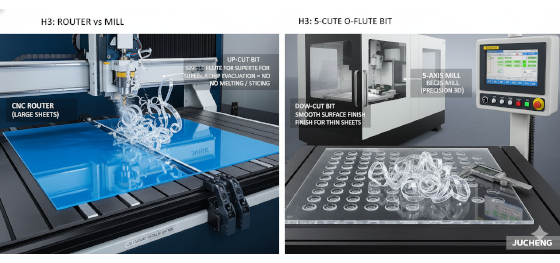
The first decision in any acrylic project is the hardware. Not all CNC machines are created equal when it comes to transparent polymers. For large-scale sheets, signage, or simple 2D profiles, the CNC router is the dominant force. These machines feature high-speed spindles and massive work envelopes, often equipped with vacuum tables that can hold a four-by-eight-foot sheet of acrylic flat without a single clamp. They are optimized for speed and large-format material removal.
However, when the complexity shifts toward three-dimensional geometries or tight-tolerance fluid manifolds, we move the work to our precision CNC mills. A mill provides the rigidity needed for 5-axis movements and the fine-tuned control over z-axis depth that a router might lack. In the context of cnc acrylic cutting, using a high-precision mill allows Jucheng Precision to achieve tolerances within microns. This is essential for optical housings where the alignment of a lens bore must be absolute. The choice of machine dictates the tool paths we program and ultimately the vibration profile the material will endure.
Tool Selection: Magic of the O-Flute
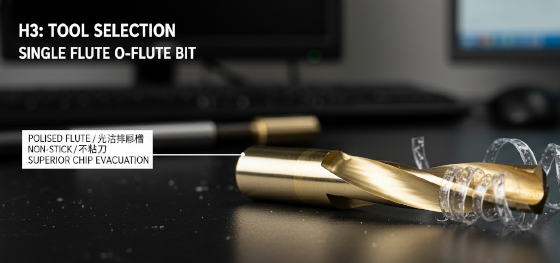
If you try to cut acrylic with a standard four-flute end mill designed for steel, you are asking for a disaster. Steel tools are built to take many small bites. In acrylic, those extra flutes provide nowhere for the heat to escape. The plastic chips get trapped in the tight valleys of the tool, melt, and eventually wrap around the shank in a "plastic weld" that ruins the part.
The secret to high-quality cnc acrylic cutting is the single-flute "O-flute" bit. This tool has a wide, open trough (the flute) that allows large, cold chips to be ejected instantly. Because there is only one cutting edge, the material spends less time in contact with hot metal during each rotation. The "O" shape refers to the specialized geometry that curls the chip and flings it away before it has a chance to soften. At Jucheng Precision, we exclusively use polished carbide O-flute bits for our acrylic projects. The mirror-polished surface of the tool reduces friction even further, leaving a finish that is often clear enough to see through directly off the machine.
Up-cut vs Down-cut: Directing the Flow
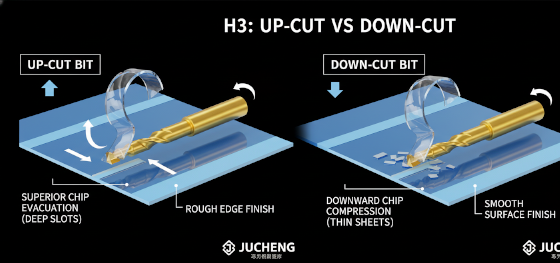
The direction in which a tool pulls the chips determines the quality of the top and bottom edges of your part. An "up-cut" spiral bit acts like a drill; it pulls the material and chips upward toward the spindle. This is fantastic for deep pockets or thick blocks because it clears the waste efficiently. But if you are cutting a thin sheet, an up-cut bit wants to lift the material off the table, leading to vibration and potential "blowout" on the top surface.
A "down-cut" bit does the opposite. It pushes the chips and the material downward against the machine bed. This provides an exceptionally clean top edge, which is vital for cosmetic panels. However, down-cutting traps chips in the groove, which can cause heat buildup if the path is too deep. Jucheng engineers often utilize a hybrid approach, using down-cut tools for the initial skin pass to secure the edge and up-cut tools for the bulk material removal. This strategic movement of chips ensures that the internal stress of the acrylic is managed, preventing the microscopic crazing that often appears weeks after a part is finished.
Speeds and Feeds: Mastering the Cool Cut
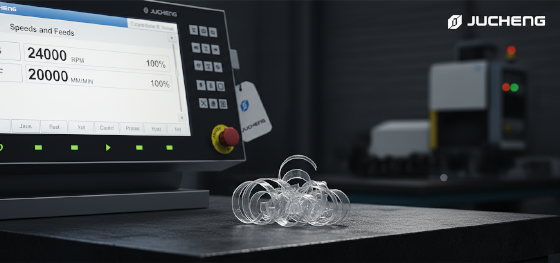
The most common mistake in plastic machining is running the spindle too fast and the feed rate too slow. This is a recipe for melting. When the tool spins rapidly but moves through the material slowly, it creates friction without removing enough material to take the heat away. You end up "rubbing" the plastic rather than cutting it.
The golden rule for cnc acrylic cutting is: High RPM, Fast Feed. You want each tooth of the cutter to take a substantial "bite" of material. That bite—the chip—absorbs the heat of the cut and carries it away as it flies off. For a standard 6mm bit, we might run at 18,000 RPM with a feed rate of 3,000 mm/min or higher. When the settings are correct, you won't see dust; you will see crisp, clean "snowflakes" of acrylic piling up. This cool-cutting strategy is what allows Jucheng Precision to maintain the structural integrity of the material, avoiding the internal stresses that cause acrylic to crack during assembly or when exposed to cleaning chemicals.
Workholding: Stability Without Damage
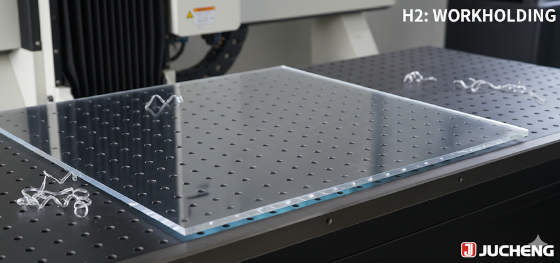
Acrylic is a visual material. If you use heavy metal clamps to hold a transparent sheet, you will almost certainly leave indentations or scratches on the surface. Worse, if the material is not held perfectly flat, the slight vibration caused by the cutter will translate into "chatter marks" on the edge of the part, destroying its optical quality.
At Jucheng Precision, our primary workholding solution for acrylic cnc machining is the high-flow vacuum table. By distributing atmospheric pressure across the entire surface of the sheet, we hold it perfectly flat without any localized stress. For 3D parts that cannot be held by vacuum, we design custom "soft jaws" or utilize specialized masking tapes and adhesives that leave zero residue. This obsession with stability ensures that the cutting tool can do its job without the material "fluttering," resulting in edges that are so smooth they require minimal secondary polishing.
Successful cnc acrylic cutting is not about the machine alone; it is about the engineer's respect for the material's limits. At Jucheng Precision, we don't just follow a CAD file. we perform a full DFM review to ensure that your radii are optimized for tool access and that your material thickness matches the chosen cutting strategy. By controlling every variable from vacuum pressure to the polish on the flute, we deliver acrylic components that are more than just parts—they are clear evidence of manufacturing excellence. Contact our team today to see how our precision plastic services can bring your transparent designs to life.

