


Selecting the wrong raw material is like building a skyscraper on a foundation of loose sand. In the world of transparent polymers, this error is subtle but catastrophic. You might receive two sheets of clear plastic that look identical, feel identical, and even carry the same brand name. However, if you choose the cheaper option for a high-precision project, the material’s "genetic makeup" will eventually fight against your design. This is the invisible but high-stakes battle of cast vs extruded acrylic.

For an engineer, the rolling or casting method of PMMA determines more than just the price per square foot. It dictates how the material reacts to the heat of a spindle, how it responds to chemical cleaning agents, and whether it will maintain its structural integrity over a five-year lifecycle. At Jucheng Precision, we consider material selection to be the first step of the manufacturing process. We have seen countless projects fail because a designer specified "acrylic" without understanding that acrylic cnc machining behaves entirely differently depending on how that plastic was born in the factory.
If your parts are destined for medical manifolds, automotive lighting, or high-end retail displays, you cannot afford to ignore the metallurgical—or rather, the macromolecular—differences between these two grades. This guide breaks down the physics of internal stress, molecular weight, and machining performance to ensure your clear designs remain crystal clear forever.
content:
Manufacturing Divide: Cells vs Machines
Internal Stress: The Silent Precision Killer
Thickness Tolerance vs Surface Uniformity
Machining Encounter: Melting and Chip Control
Polishing Potential: Achieving Optical Grade Clarity
JUCHENG's Verdict: Why We Trust Cast
Manufacturing Divide: Cells vs Machines

The difference in cast vs extruded acrylic starts at the very beginning of the material’s life. Cell Cast Acrylic is produced by pouring a liquid monomer (MMA) between two high-quality glass plates. These plates are clamped together, and the material is allowed to polymerize—a slow, patient chemical reaction that builds incredibly long molecular chains. This "batch" process is time-consuming and labor-intensive, but it results in a material with massive molecular weight and a highly stable, random molecular structure. It is essentially the "small-batch artisanal" version of plastic.
Extruded Acrylic is the product of mass production. Pellets of acrylic resin are fed into a heated hopper, melted into a thick paste, and then forced through a high-pressure die by a massive screw. The plastic is pushed between rollers to achieve the final thickness. This process is incredibly efficient and produces miles of material per day. However, that intense physical pressure forces the polymer chains to align in the direction of the extrusion. These shorter, "stretched" chains are under constant tension, creating a material that is ready to fail the moment it encounters the heat of a CNC tool or the stress of a drill bit.
Internal Stress: The Silent Precision Killer
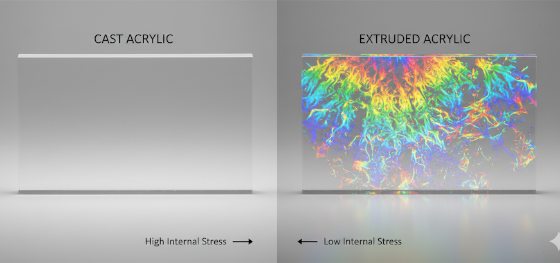
If you look at both materials under normal light, they look identical. But at Jucheng Precision, we use polarized filters to inspect raw stock. Under polarized light, extruded acrylic reveals a chaotic rainbow of "frozen stress" patterns. Because the material was forced through a die, those polymer chains are like thousands of tiny, coiled springs. When we remove material from an extruded sheet during acrylic cnc machining, we are cutting those springs. The result is almost always warping. A flat panel made of extruded acrylic will often bow or cup within hours of being removed from the machine.
Even more dangerous is a phenomenon called "crazing." Those internal stresses are constantly trying to pull the material apart. If an extruded acrylic part is exposed to any solvent—even standard window cleaner or Isopropyl alcohol—those microscopic stress lines will suddenly erupt into thousands of tiny white cracks. Cast acrylic has virtually no internal stress because it was allowed to form naturally in a mold. In the cast vs extruded acrylic comparison, cast is the clear winner for any part that must remain structurally stable and aesthetically perfect for years of service in varied environments.
Thickness Tolerance vs Surface Uniformity
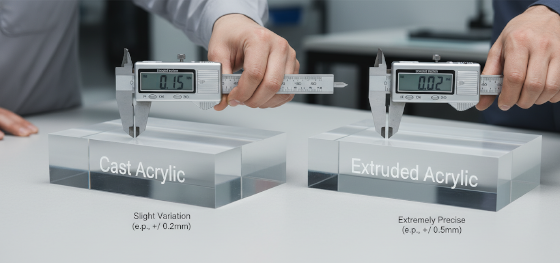
There is one area where extruded acrylic actually wins: thickness consistency. Because it is pushed between precision metal rollers, a 10mm extruded sheet will measure almost exactly 10mm across its entire surface, usually with a tolerance of +/- 0.1mm. This makes it popular for simple laser cutting or signage where the material must fit into a standardized track. If your design relies on the raw thickness of the sheet as a critical dimension, extrusion offers the easiest path.
Cast acrylic is much sloppier. Because it is poured between glass plates that can bow slightly under the weight of the liquid, the thickness can vary significantly across a single sheet. A "10mm" cast sheet might be 9.5mm at the edge and 10.5mm in the center. However, for precision CNC machining, this doesn't matter to us at JUCHENG. Our first step for critical parts is often a "skimming" pass, where we mill the material to a perfectly uniform thickness ourselves. We trade the initial thickness tolerance of extrusion for the superior chemical stability of cast, knowing that we can fix the dimensions but we cannot fix the chemistry.
Machining Encounter: Melting and Chip Control
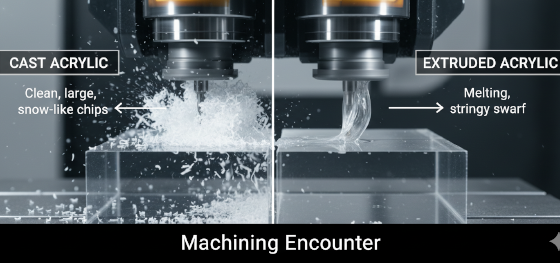
The most dramatic evidence of the cast vs extruded acrylic divide appears the moment the tool hits the plastic. Cast acrylic has a higher molecular weight, which translates to a higher melting point. When we cut cast acrylic, it produces crisp, cold flakes that fly away from the tool. The material has enough structural integrity to resist the heat generated by the friction of the cut. It feels much more like machining a soft metal than a plastic.
Extruded acrylic is "gummy." Because the molecular chains are shorter, the material softens at a much lower temperature. If the tool path dwells in one spot for even a fraction of a second, the chips will begin to melt and weld themselves back onto the part or, worse, fuse to the tool flutes. Machining extruded acrylic requires much slower speeds and aggressive air cooling to prevent a "plastic meltdown." For Jucheng Precision’s high-speed 5-axis centers, cast acrylic is the only material that can keep up with our production pace without risking a ruined part.
Polishing Potential: Achieving Optical Grade Clarity

If your goal is optical clarity—the kind needed for luxury automotive lenses or medical diagnostics—there is no contest. Cast acrylic is the gold standard for polishing. Because it is harder and more stable, it accepts mechanical buffing and vapor polishing with incredible results. The surface remains clear and brilliant. Because it has no grain direction, the polish is uniform regardless of which angle you are looking from.
Extruded acrylic reacts poorly to high-end polishing. During vapor polishing, the chemical gas attacks the aligned polymer chains and can cause the material to "frost" or become cloudy. Even with hand polishing, the heat from the buffing wheel often causes the surface to "roll" or smear rather than cut, leaving a hazy finish that looks unprofessional. At JUCHENG, we refuse to use extruded acrylic for any part requiring a high-gloss or vapor-polished finish. We believe that if you are paying for precision acrylic cnc machining, you should receive a part that is truly transparent, not just "mostly clear."
JUCHENG's Verdict: Why We Trust Cast

The final decision in the cast vs extruded acrylic debate is a balance between initial material cost and the total cost of quality. Extruded acrylic is cheaper per sheet, but it carries a high hidden cost in scrap rates, warping, and delayed cracking. It is perfectly suitable for simple retail signage or protective covers that don't require tight tolerances. But for anything involving high-value engineering, it is a liability.
At Jucheng Precision, we have made a strategic choice. We exclusively use high-quality cell cast acrylic for all our precision CNC machining and prototyping projects. This decision allows us to offer our clients a 100% guarantee against stress-cracking and material warping. We believe that the slight premium in raw material cost is a small price to pay for the peace of mind that comes with superior performance. Whether you are building a complex prototype for a light pipe or a structural medical manifold, let our engineers guide you to the right material. Upload your CAD file today and experience the clarity that only high-end cast acrylic and expert machining can provide.

