


Your new 5G amplifier needs to dissipate a huge amount of heat. Your electric vehicle's battery needs a highly efficient way to transfer current. For these jobs, there is no substitute. You need the king of conductivity. You need copper.
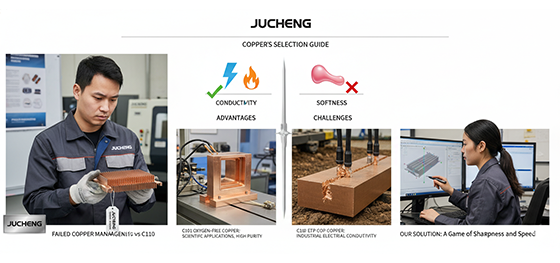
But then you talk to a machinist. And they groan. Because the same property that makes copper an electrical and thermal superhero, also makes it a villain on the CNC machine.
Providing high-quality copper cnc machining services is a true test of a manufacturer's skill. It is a battle against a soft, sticky, and frustratingly difficult material. This guide will take you inside that battle.
Copper's Double-Edged Sword: A Machinist's Paradox
Choosing Your Copper: C101 vs. C110
The Nightmare of a 'Gummy' Metal
Our Solution: A Game of Sharpness and Speed
Copper's Double-Edged Sword: A Machinist's Paradox

Copper's greatest strength is its free-flowing electrons. This is what makes it an almost perfect conductor of electricity and heat. It is second only to silver. This makes it an essential choice among CNC machining materials for any thermal or electrical application.
But this same "soft" electronic structure also contributes to its physical properties. Pure copper is very soft and ductile. It is "gummy." This is the source of the paradox. The very thing that makes it a great conductor also makes it a terrible material to machine.
Choosing Your Copper: C101 vs. C110

When specifying copper, two grades are the most common.
Copper C110, or Electrolytic Tough Pitch (ETP) copper, is the workhorse. It is the standard for most electrical applications, like wiring and busbars. It has excellent conductivity and is relatively cost-effective.
Copper C101, also known as Oxygen-Free Copper (OFC), is the high-performance champion. It has been refined in a special process to remove almost all oxygen. This tiny change makes it slightly more conductive than C110. But more importantly, it makes it perform much better in a vacuum. It is the required choice for high-end applications like semiconductor components, vacuum tubes, and aerospace electronics.
| Property | C110 (ETP) Copper | C101 (OFC) Copper |
|---|---|---|
| Conductivity (IACS) | 100% | 101% |
| Purity | ~99.9% | ~99.99% (Oxygen-Free) |
| Best For | General Electrical, Busbars, Heat Sinks | High-Vacuum, Aerospace, High-End Audio |
The Nightmare of a 'Gummy' Metal
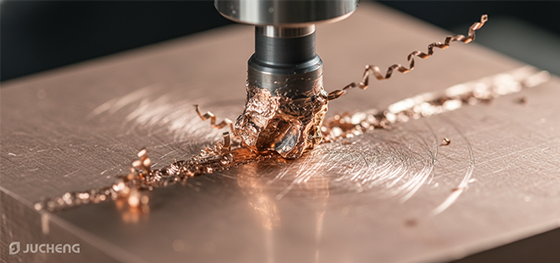
The biggest challenge in machining copper is its "gummy" nature. A cutting tool does not create a clean, brittle chip. Instead, the soft copper tends to stick to the cutting edge.
This creates a "built-up edge" (BUE). A small piece of copper literally welds itself to the tool. This instantly makes the tool dull. A dull tool does not cut. It plows. It smears the material, leaving a terrible surface finish with a lot of burrs.
This built-up edge also generates a huge amount of heat. Because copper is such a great heat conductor, this heat instantly spreads through the entire part. For a thin part like a heat sink, this can cause it to warp and deform right on the machine. It is a machinist's nightmare.
Our Solution: A Game of Sharpness and Speed

So how do you tame this sticky beast? High-quality copper cnc machining services rely on a specific set of strategies.
First, the cutting tools must be unbelievably sharp. We use brand new, solid carbide end mills with a very high rake angle and a special, super-slick coating. The goal is to slice the copper cleanly, with as little friction as possible.
Second, you must use very high speeds. The machine's spindle speed must be extremely fast, and the feed rate must be aggressive. This might seem counterintuitive. But the strategy is to form the chip and get it away from the part as quickly as possible, giving it no time to stick to the tool.
Finally, a generous flood of high-quality coolant is absolutely essential. It lubricates the cut and, most importantly, immediately washes away the heat and the sticky chips.
At JUCHENG, our expertise in high-speed machining and our investment in advanced tooling are key to our success. We have the experience to turn this difficult, gummy material into the perfect, burr-free, high-performance component your 5G and EV projects demand.

