


Procurement managers and product developers frequently encounter wide disparities when soliciting quotes for custom manufactured components. The final Rapid Prototyping Cost rarely correlates simply with the physical size or weight of the intended object. Instead, pricing reflects a complex aggregation of material science, machine hourly rates, geometric complexity, and labor-intensive post-processing requirements. A machined aluminum enclosure might cost five hundred dollars in a prototype quantity of one, yet drop to fifty dollars per unit when ordered in a batch of one hundred. Understanding the underlying economic drivers allows engineers to optimize their designs specifically for manufacturing efficiency. Ignoring these critical cost factors inevitably leads to blown budgets and delayed product launches. Smart design choices made early in the CAD phase directly dictate the financial viability of the entire hardware project.
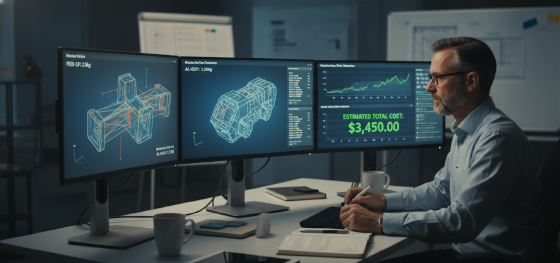
Transitioning a digital concept into a physical reality involves selecting the correct manufacturing pathway based on budget constraints and functional requirements. Additive manufacturing technologies like SLA or FDM offer low entry costs for singular units but scale poorly for volume production. Conversely, Subtractive CNC machining demands higher upfront programming and setup investments but delivers superior per-unit economics as quantities increase. Navigating these trade-offs requires a transparent analysis of non-recurring engineering costs versus variable unit costs. Experienced B2B buyers do not merely seek the lowest sticker price; they seek the optimal balance between part quality, lead time speed, and total project expenditure. Analyzing the specific breakdown of these expenses reveals hidden opportunities for significant savings.
Raw Material Volumetric Pricing and Waste Factors
Machine Run Time and Geometric Complexity Impacts
Additive Manufacturing Price Tier Comparisons
The Setup Cost Amortization Curve in CNC Machining
Vacuum Casting Economics for Bridge Production
Surface Finishing Labor Rates and Quality Standards
Hidden Logistics and Expedited Shipping Expenses
Jucheng Precision Cost Optimization Strategies
Raw Material Volumetric Pricing and Waste Factors
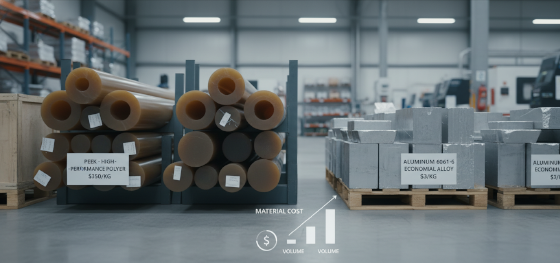
Material selection serves as the foundational baseline for any manufacturing quote. Engineering thermoplastics like PEEK or Ultem carry raw material price tags significantly higher than standard aluminum 6061 or ABS plastics. However, the sticker price of the stock block only tells half the story. Subtractive manufacturing processes inherently generate waste. Machining a complex aerospace bracket from a solid rectangular billet might result in removing eighty percent of the original material as metal chips. The client pays for the entire initial block, not just the final part weight. Consequently, designing parts that conform closer to standard stock sizes reduces the amount of wasted material and lowers the raw purchase cost.
Additive manufacturing flips this cost equation by utilizing material only where physically needed. Powder bed fusion and filament extrusion systems generate minimal waste, making them economically superior for geometries with high void volumes or expensive exotic materials. However, certain 3D printing resins used in SLA processes remain costly per liter compared to injection molding pellets. Balancing the "buy-to-fly" ratio—the difference between raw stock weight and final part weight—remains a critical skill for cost-conscious engineers. Selecting a slightly lower grade alloy or a standard plastic formulation often yields identical functional results while slashing the bill of materials by thirty percent.
Machine Run Time and Geometric Complexity Impacts
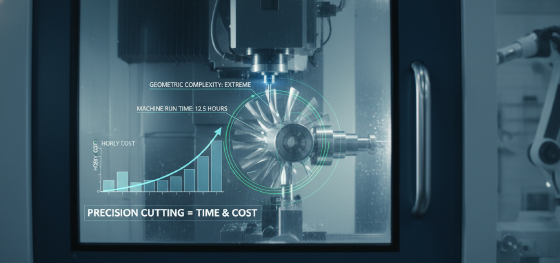
Machine time represents the most direct variable cost in precision manufacturing. A 5-axis CNC machining center charges a significantly higher hourly rate than a standard 3-axis mill due to its operational capability and equipment amortization. Design features that demand complex, simultaneous multi-axis movements force the machine to run slower to maintain tolerance, directly increasing the billable hours. Deep, narrow pockets require specialized long-reach tooling and slow feed rates to prevent chatter, further extending the cycle time. Adding internal sharp corners that cannot be cut by a rotating round tool necessitates secondary EDM (Electrical Discharge Machining) processes, effectively doubling the manufacturing steps for a single feature.
Simplifying geometry to align with standard machining practices offers the fastest route to cost reduction. Designing parts that can be machined from one or two orientations drastically reduces the need for manual re-fixturing by the operator. Every time a machinist must stop the spindle to rotate the part, labor costs accumulate. For 3D printing, Z-axis height dictates the print duration. Orienting a tall, thin part flat against the build plate reduces the total number of layers, significantly cutting down the laser or extruder run time. optimizing the "machinability" of a design creates immediate financial savings without compromising functionality.
Additive Manufacturing Price Tier Comparisons
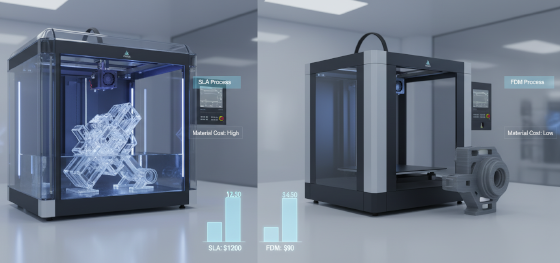
Not all 3D printing technologies carry the same price tag. Fused Deposition Modeling (FDM) generally sits at the most affordable tier, utilizing standard thermoplastic filaments like ABS or PLA. It serves as the ideal solution for rough fit-checks and early-stage concept models where surface finish is secondary to speed and cost. Stepping up to Stereolithography (SLA) increases the cost due to the expensive photosensitive resins and the post-curing labor required, but it delivers smooth, injection-mold-like surface quality. Engineers willing to pay for aesthetic precision often justify this premium for marketing samples or visual verification models.
Industrial powder bed fusion technologies like Selective Laser Sintering (SLS) and Multi Jet Fusion (MJF) occupy a higher price bracket. These systems run nylon powders that produce fully functional, durable end-use parts. While the machine time is costly, these processes require no support structures, allowing hundreds of parts to be nested into a single build chamber. This "nesting density" dramatically lowers the per-unit cost for batches of fifty to five hundred parts, making it competitive with injection molding for small runs. Direct Metal Laser Sintering (DMLS) remains the most expensive option, reserved strictly for aerospace or medical components where a metal part is impossible to manufacture via CNC machining.
The Setup Cost Amortization Curve in CNC Machining
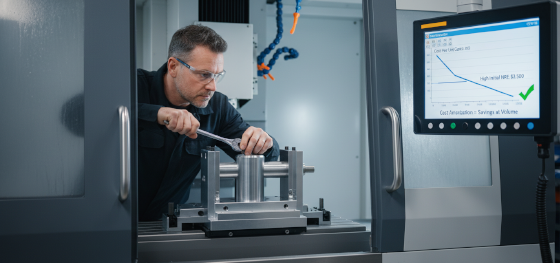
CNC machining involves significant Non-Recurring Engineering (NRE) costs before the first chip is ever cut. A programmer must spend hours creating the CAM toolpaths, and a machinist must physically set up the vises, calibrate the tools, and prove out the first article. If a client orders a single prototype, that one part bears 100% of this setup fee, resulting in a high unit price. However, once the machine is running, the secondary recurring cost is only the material and the cycle time. ordering ten parts instead of one spreads that initial setup fee across ten units, causing the price per part to plummet.
This amortization curve creates a specific economic behavior. CNC machining becomes increasingly cost-effective as volume rises from one to one thousand. For extremely low quantities (1-5 units), the setup time often exceeds the actual machining time. Smart procurement managers utilize this logic by grouping orders. Instead of ordering five prototypes this week and five next week, ordering ten at once eliminates a redundant setup charge. Understanding this "economy of scale" within the prototyping realm allows budget-constrained startups to access high-precision machined parts that would otherwise be cost-prohibitive.
Vacuum Casting Economics for Bridge Production
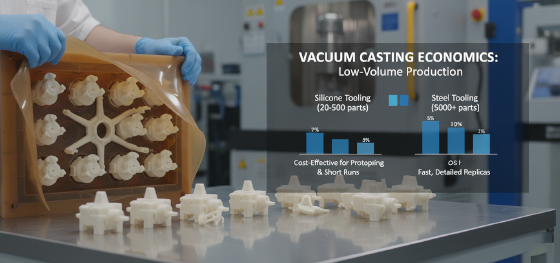
When project requirements demand twenty to fifty functional plastic parts, CNC machining becomes too slow, and 3D printing may lack the specific material properties required. Hard steel injection molds are far too expensive and slow for such low volumes. Vacuum Casting (Urethane Casting) fills this specific economic gap. The process involves creating a master pattern (usually via SLA printing) and pouring liquid silicone around it to form a soft mold. This silicone mold is significantly cheaper and faster to produce than a metal tool, typically costing hundreds rather than thousands of dollars.
A single silicone mold can produce approximately twenty copies before degrading. This puts the "sweet spot" for vacuum casting pricing squarely between rapid prototyping and mass production. The unit cost is higher than injection molding but lower than CNC machining for these specific quantities. Additionally, urethane resins can mimic the properties of production ABS, PC, or rubber, providing production-grade performance without the capital risk of hard tooling. For medical device trials or automotive marketing fleets, vacuum casting offers the most logical cost-benefit ratio for bridge production.
Surface Finishing Labor Rates and Quality Standards
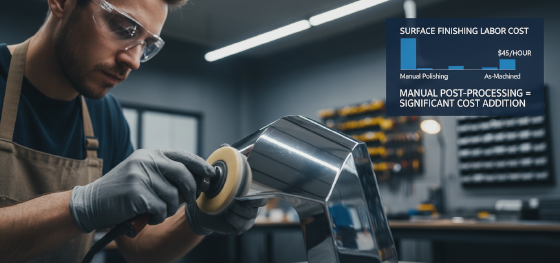
Post-processing often represents the "hidden" cost driver that surprises many designers. A standard "as-machined" or "as-printed" finish requires minimal manual intervention, keeping costs low. However, requesting a glossy optical clear polish, a specific color-matched anodization, or a textured powder coat involves significant skilled manual labor. Hand-sanding a 3D printed part to remove layer lines takes hours of human effort. Since labor rates are a fixed component of the manufacturing bid, high-end cosmetic requirements linearly increase the price.
Specifying surface finishes strictly where needed is a key cost control strategy. Internal components that will never be seen by the end-user should remain "as-machined" (Ra 3.2 or similar). Only external cosmetic surfaces should receive expensive treatments like bead blasting or laser engraving. Over-specifying tolerances also drives up cost; demanding a +/- 0.01mm tolerance on a clearance hole forces the machinist to slow down and inspect more frequently, whereas a standard tolerance allows for rapid production. aligning the finish specification with the actual function prevents paying for unnecessary aesthetic perfection.
Hidden Logistics and Expedited Shipping Expenses
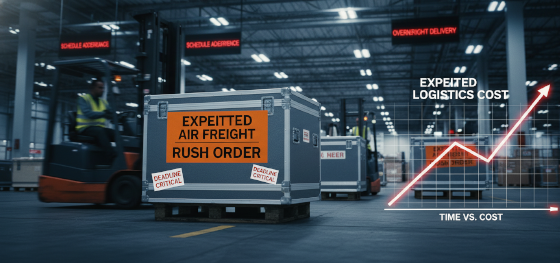
Global manufacturing involves moving physical atoms across borders. Logistics costs can easily consume twenty percent of a prototyping budget if not managed correctly. Heavy metal parts machined from stainless steel incur massive air freight charges compared to lightweight nylon prints. Furthermore, splitting orders between multiple vendors—one for machining, one for anodizing, one for assembly—multiplies the shipping fees and administrative overhead. Every transit leg adds risk of delay and damage, potentially triggering expensive "rush" shipping fees to recover lost time.
Consolidating production with a single one-stop supplier eliminates these intermediate logistic costs. A partner capable of handling the fabrication, finishing, and assembly under one roof allows for a single final shipment. Additionally, planning the timeline to allow for standard air freight rather than "priority overnight" options saves significant capital. While speed is often the primary goal of rapid prototyping, calculating the premium paid for 24-hour turnaround versus 3-day turnaround helps managers decide if the speed is truly worth the exponential cost increase.
Jucheng Precision Cost Optimization Strategies
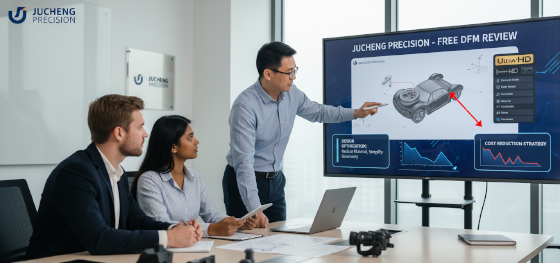
Fragmented supply chains and rigid pricing structures often penalize innovation. Jucheng Precision disrupts this model by actively partnering with clients to reduce their total project costs. Our Free DFM (Design for Manufacturability) Review service acts as a financial firewall; our engineers analyze your CAD files before production begins, identifying cost-driving features like deep undercut pockets or unnecessary tight tolerances. By suggesting minor geometry changes, we often help customers save upwards of thirty percent on machining time without altering the part's function. We operate as a comprehensive manufacturing ecosystem, not just a job shop.
Our facility integrates over 150 CNC machines, industrial SLA/SLS/SLM printers, and vacuum casting chambers within an 8000-square-meter campus. This vertical integration allows us to offer blended manufacturing solutions—such as CNC machining a master pattern for vacuum casting—without external markup fees. Crucially, our "No MOQ" (Minimum Order Quantity) policy empowers startups to order exactly what they need, whether it is one complex prototype or five hundred bridge production units. Backed by ISO9001:2015 and IATF16949 certifications, Jucheng Precision delivers Fortune 500 quality at a cost structure viable for agile product development. We turn your budget constraints into strategic manufacturing advantages.

