


Your design demands the impossible. It needs the excellent corrosion resistance of a 300-series stainless steel. But it also needs the extreme strength and hardness of a heat-treated alloy steel. You are trapped between two worlds.

You cannot choose one without sacrificing the other. Or can you?
There is a special class of materials designed to solve this exact dilemma. They are hybrid champions, combining the best of both worlds. The undisputed king of this class is 17-4 PH. And the process of 17-4 ph stainless steel machining is the art of shaping this superpower.
Unveiling a Hybrid Champion
'PH': The Secret to its Super Strength
A Machinist's Strategic Battle
Your Partner in High-Strength Solutions
Unveiling a Hybrid Champion

17-4 PH is a unique grade of stainless steel. Its name is a code that reveals its recipe. "17-4" means it contains approximately 17% chromium and 4% nickel.
The chromium provides excellent corrosion resistance, comparable to the 304 grade. But 17-4 has a secret ingredient that 304 does not: copper. This small addition of copper is the key to its incredible strength. It also gives the material a martensitic crystal structure, which means, unlike 304, 17-4 PH is magnetic.
'PH': The Secret to its Super Strength
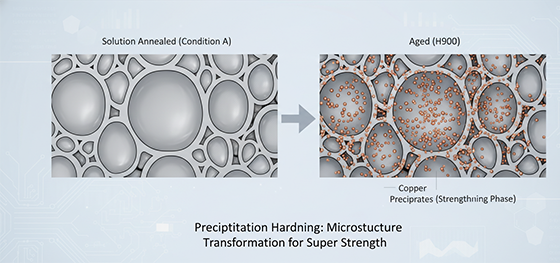
The "PH" in its name stands for Precipitation Hardening. This is a special type of heat treatment that gives 17-4 its superpowers. It is a "secret weapon" that other stainless steels in the 300 series do not have.
The process is fascinating. First, the material is "solution annealed" (Condition A). It is heated to a high temperature to dissolve all the elements into a uniform solid solution. In this state, it is relatively soft and easy to machine.
Then, after machining, the part is "aged." It is heated to a lower temperature for a specific time. This causes the tiny copper particles to "precipitate" out of the solution and form microscopic, needle-like structures within the steel's grain. These tiny copper needles act like nails. They lock the material's crystal lattice in place, making it incredibly difficult for it to deform.
By changing the aging temperature and time, we can achieve different levels of hardness. The most common is H900, which results in a material that is 3 to 4 times stronger than 316 stainless steel. This is how 17-4 PH bridges the gap to alloy steel performance.
A Machinist's Strategic Battle

This incredible hardness makes 17-4 ph stainless steel machining a serious challenge, especially in its hardened state. It is a battle that requires strategy.
The most common strategy is to machine the part in its softer, annealed state (Condition A). This is much easier on the cutting tools. Then, after the part is fully machined, it is sent for the final hardening heat treatment. The challenge with this method is that the part can slightly distort during the heat treat process.
The other strategy is "hard machining." This involves machining the material after it has already been hardened to a state like H900. This is extremely difficult. It requires very rigid and powerful CNC machines. It demands the use of advanced, coated carbide or ceramic cutting tools. And it must be done at very slow speeds with a huge amount of coolant.
This method provides the best possible dimensional accuracy, as there is no risk of post-machining distortion. Only expert manufacturers with the right equipment can successfully perform hard machining on 17-4 PH.
| Property | 17-4 PH (H900) | 316L Stainless Steel |
|---|---|---|
| Yield Strength | ~1170 MPa (Extreme) | ~241 MPa (Good) |
| Hardness (Rockwell C) | ~44 HRC | ~- HRC (Cannot be hardened) |
| Corrosion Resistance | Excellent (Similar to 304) | Superior (Marine Grade) |
| Magnetic? | Yes | No |
Your Partner in High-Strength Solutions

When do you choose this hybrid champion?
You choose 17-4 PH when you need a part with the mechanical strength of an alloy steel, but you cannot afford for it to rust. It is the top choice for high-strength, precision components in the aerospace, defense, and oil & gas industries. Think of valve bodies, aircraft fittings, and shafts.
Working with a material this advanced requires an advanced partner. At JUCHENG, our expertise in both machining tough stainless steel cnc machining alloys and managing complex heat treatment processes makes us the ideal choice. We can deliver your 17-4 PH components to the exact hardness and dimensional specifications your critical application demands.

