


Steel is not a monolithic material. Before it ever reaches a CNC spindle, it undergoes intense physical transformations that dictate its final personality. If you walk through the material racks at Jucheng Precision, you will notice a stark visual divide. Some bars are black, rough, and industrial; others are bright, oily, and sharp-edged. This visual difference represents the fundamental choice between hot vs cold rolled steel.
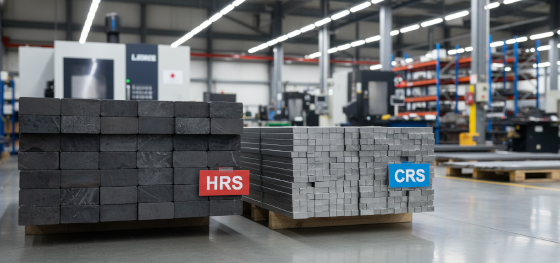
For the uninitiated, steel is just steel. But for a manufacturing engineer, the rolling process is a critical variable that affects dimensional tolerance, surface integrity, and internal stress. Choosing the wrong starting blank can lead to parts that warp during cutting or tools that dull prematurely against mill scale. As a leader in high-precision CNC Steel Machining, JUCHENG understands that the success of a project starts with the metallurgy of the raw stock.
Price often drives the initial conversation, but the true cost of a part is determined on the machine bed. This guide explores the technical boundaries of 1018 and other carbon steels in their different rolled states, helping you select the right foundation for your precision components.
Thermal Origin: Heat vs Room Temperature
Dimensional Tolerance: Precision or Roughness
Surface Integrity: Dealing with Mill Scale
Internal Stress: The Hidden Warping Risk
Technical Comparison of Rolled States
JUCHENG's Verdict: Making the Right Call
Thermal Origin: Heat vs Room Temperature
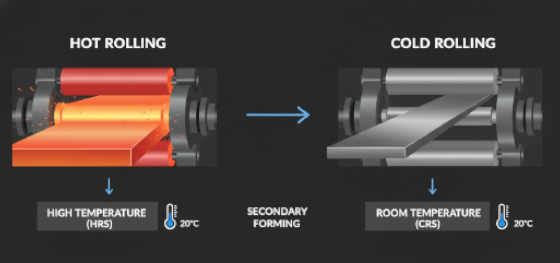
The names are literal. Hot Rolled Steel (HRS) is processed at extreme temperatures, typically over 1,700°F. This is above the steel’s recrystallization temperature. At this heat, the metal is plastic and easy to deform. Huge rollers squash the glowing billets into shapes like I-beams or thick plates. Because the metal is so hot, it scales and shrinks unpredictably as it cools to room temperature. This results in a material that is relaxed but physically imprecise.
Cold Rolled Steel (CRS) starts its life as hot rolled steel. However, it undergoes an extra step. Once the metal is cool, it is processed again through "cold reduction" mills or drawn through dies at room temperature. This is essentially a form of high-pressure stretching and squeezing. Because it happens at room temperature, there is no cooling shrinkage. The metal is work-hardened, becoming denser and stronger during the process. In the context of hot vs cold rolled steel, the cold version is a refined, high-performance evolution of the hot-rolled base.
Dimensional Tolerance: Precision or Roughness
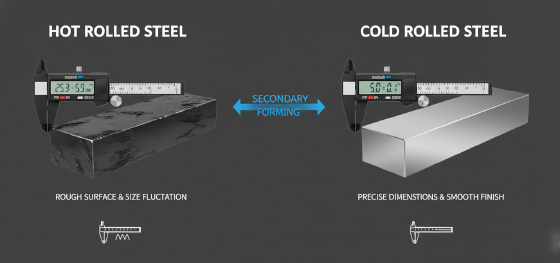
In our machining center, the first thing we measure is the "blank" size. This is where the hot vs cold rolled steel choice hits the budget. Hot rolled steel is notoriously sloppy with dimensions. A 1-inch hot rolled bar might actually measure 1.05 inches in one spot and 0.98 inches in another. It is often slightly out-of-round. If you are making a structural bracket where the raw surface is left as-is, this doesn't matter. But for precision components, you must machine away every square millimeter of the surface to find the "true" center.
Cold rolled steel is the opposite. It is remarkably consistent. A 1-inch cold drawn bar will measure exactly 1 inch (or very close to a specific h-tolerance) along its entire length. For CNC Steel Machining, this is a massive advantage. We can often use the raw material surface as a "datum" or a finished feature. This saves machine time because we don't have to "clean up" the material before starting the real work. If your part requires tight concentricity, starting with a CRS blank is a technical necessity.
Surface Integrity: Dealing with Mill Scale
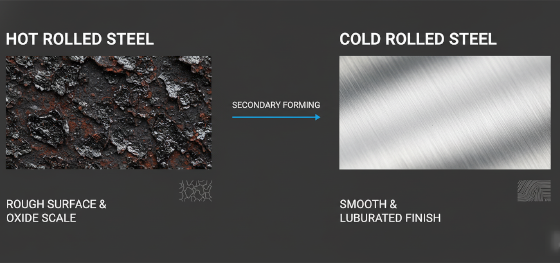
Look at the skin of the metal. Hot rolled steel is covered in "mill scale"—a thin, black layer of oxidized iron. This scale is surprisingly hard and abrasive. It is the enemy of carbide inserts. When we machine hot rolled stock, the first "skin cut" is always the most dangerous for the tool. The scale chips the cutting edge. JUCHENG machinists have to run these first passes at lower speeds to survive the abrasion.
Cold rolled steel arrives with a smooth, oily, and scale-free finish. It looks almost like it has already been machined. This smooth skin allows for higher initial cutting speeds and much more predictable tool life. Beyond the machine shop, if your part requires painting or plating, cold rolled steel is much easier to prep. Hot rolled steel requires sandblasting or pickling to remove that black scale before any coating will stick. If aesthetic finish is a priority, cold rolled steel is always the winner in the hot vs cold rolled steel comparison.
Internal Stress: The Hidden Warping Risk
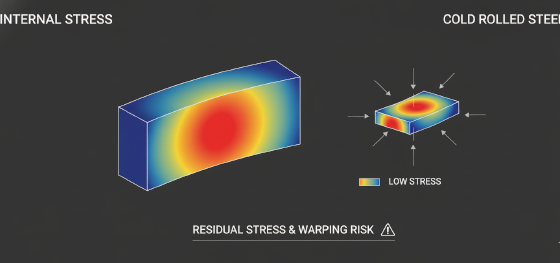
This is the technical nuance that many designers forget. Cold rolling involves massive physical pressure that "traps" energy inside the metal grains. This is called residual stress. When you start removing material from one side of a cold-rolled plate during CNC Steel Machining, you are releasing that trapped energy. The metal reacts by bending or bowing. It is the "CRS Warp."
Hot rolled steel is much more stable. Because it cooled slowly from a plastic state, the internal stresses are very low. If you machine a long, thin channel into a hot rolled plate, it will likely stay flat. If you do the same to a cold rolled plate, it might turn into a banana. At Jucheng Precision, we manage this by suggesting stress-relief annealing for critical CRS parts, or by carefully selecting HRS for large-scale structural plates where flatness is more important than surface beauty.
Technical Comparison of Rolled States
To help you choose, here is how the two conditions stack up in the metrics that matter most to production managers and engineers.
| Feature | Hot Rolled Steel (HRS) | Cold Rolled Steel (CRS) |
|---|---|---|
| Surface Finish | Rough, Scaly, Black | Smooth, Shiny, Oily |
| Tolerances | Loose (+/- 0.02" typical) | Tight (+/- 0.002" typical) |
| Internal Stress | Very Low (Stable) | High (Prone to warping) |
| Material Cost | Lower (Economy) | Higher (Premium) |
| Hardness/Strength | Standard | Higher (due to work hardening) |
JUCHENG's Verdict: Making the Right Call
The debate over hot vs cold rolled steel is not about finding the "best" material, but finding the "correct" starting point for your manufacturing process. If you start with the wrong blank, you pay for it in machine time, tool breakage, or rejected parts.
Use Hot Rolled Steel if: You are building structural frames, large mounting plates, or construction components where precision is handled by loose bolt holes. It is the economical choice for bulk and mass.
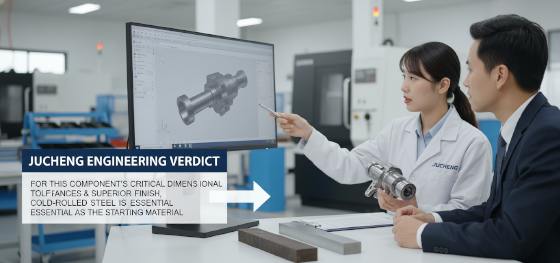
Use Cold Rolled Steel if: You are designing precision axles, gears, connectors, or any part requiring CNC Steel Machining with tight tolerances. The higher initial material cost is easily offset by the reduction in machine time and the superior surface quality.
Jucheng Precision stocks both types of raw materials and provides a comprehensive DFM review for every quote. We don't just follow the print; we look at your design and suggest the starting material that will give you the most stable, cost-effective result. Upload your CAD files today and let our engineers help you build a better steel part.
```

