


The transition from basic fabrication to true mechanical engineering often begins with a single material choice. While mild steels like 1018 are the kings of brackets and frames, they often fail when the application demands real structural integrity or wear resistance. This is where the industry turns to a mid-range powerhouse. The decision to move toward machining 1045 steel usually occurs the moment a part needs to survive more than just a static load—it needs to move, rotate, and endure.
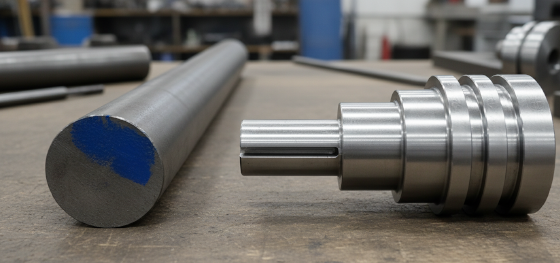
AISI 1045 is a medium carbon steel that occupies a critical foundational role in CNC Steel Machining, serving as the primary choice for shafts, axles, and gears worldwide. It offers a significant leap in strength over low-carbon alternatives while remaining surprisingly affordable. At Jucheng Precision, we view 1045 not just as a metal, but as a responsive canvas that can be tuned through heat treatment to meet precise hardness requirements.
If your components are failing due to surface wear or insufficient yield strength, 1045 might be the solution you have been overlooking. This guide explores the metallurgical advantages of this grade and how JUCHENG optimizes the machining process to deliver high-performance drive components for our global partners.
The Mid-Range Powerhouse: Chemical Composition
Cutting Beyond the Surface: Machinability Facts
The Transformation: Hardening and Tempering
Moving the World: Shafts and Industrial Gears
JUCHENG Precision: Managed Steel Life Cycles
The Mid-Range Powerhouse: Chemical Composition
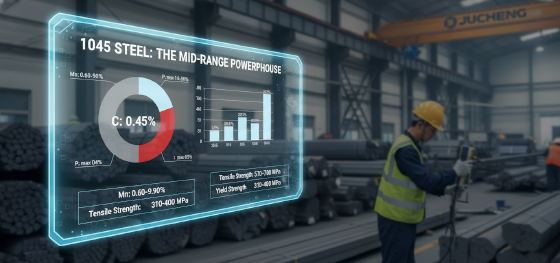
To understand the performance of 1045, one must look at the carbon. Unlike 1018, which only contains about 0.18% carbon, 1045 sits in the "sweet spot" of 0.43% to 0.50%. This roughly 0.45% carbon content fundamentally changes the steel's crystal structure, shifting it from a mostly ferrite (soft) matrix to a mixture of ferrite and pearlite.
This extra carbon is the engine of its strength. It provides 1045 with a tensile strength of approximately 570 MPa in its normalized state, nearly 30% higher than mild steel. For engineers, this means 1045 parts can handle much higher torque and rotational forces without deforming. Additionally, 1045 contains a healthy amount of manganese, which improves the material's hardenability—a critical factor when we move the parts from the CNC machine to the heat treatment furnace.
Cutting Beyond the Surface: Machinability Facts
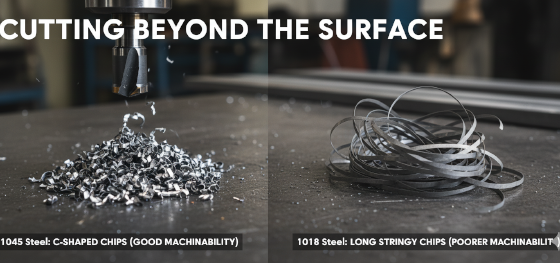
From a machinist's perspective, 1045 is often preferred over the "stickier" low-carbon grades. While machining 1045 steel, tool life is surprisingly predictable because the material has enough hardness to allow for clean chip fracturing. It does not "smear" like 1018. Instead, it produces crisp, C-shaped chips that are easily evacuated from the cutting zone.
At Jucheng Precision, we leverage this stability to achieve high-quality surface finishes. Because the material is more rigid, it is less prone to vibration (chatter) during long-bed turning operations. We typically use CVD-coated carbide inserts to handle the higher abrasive wear of the pearlite structure. By maintaining aggressive feed rates and utilizing modern tool geometries, we can deliver 1045 parts with Ra 0.8 surface finishes directly off the lathe, reducing the need for costly secondary grinding operations.
The Transformation: Hardening and Tempering

The true "magic" of 1045 lies in its response to heat. While mild steel cannot be hardened significantly, 1045 is highly responsive to quenching. This is the stage where a basic steel part becomes a high-performance industrial component.
We commonly perform Induction Hardening on 1045 shafts. By rapidly heating the surface with an electromagnetic coil and then quenching it with water or oil, we can create a glass-hard surface layer (up to 50-55 HRC) while the core remains ductile and shock-resistant. This "case" provides incredible wear resistance for parts that are in constant contact with bearings or seals. Alternatively, "Through Hardening" (Quench and Temper) can be used to improve the overall toughness and tensile strength of the entire part. JUCHENG manages this entire process, ensuring the tempering cycle correctly balances the new hardness with the necessary fracture toughness.
Moving the World: Shafts and Industrial Gears
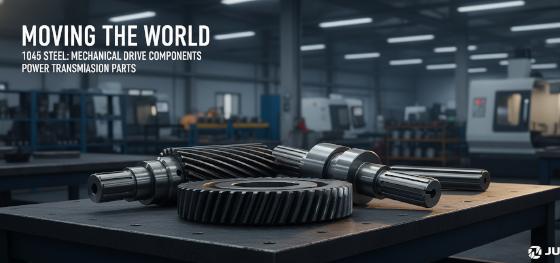
Because of its balanced properties, 1045 is the undisputed king of power transmission. Look at any conveyor system, hydraulic pump, or industrial gearbox, and you will likely find 1045 steel at the core.
Common applications include pump shafts, motor axles, heavy-duty studs, and large industrial gears. Its ability to hold tight tolerances during turning makes it perfect for long, slender components that require high straightness. For gears, 1045 provides the necessary tooth strength to prevent shearing under load. When combined with flame or induction hardening on the gear teeth, it offers a lifespan that far exceeds cheaper carbon steels. If your application involves rotation, friction, or torque, 1045 is almost always the most cost-effective engineering solution.
JUCHENG Precision: Managed Steel Life Cycles

Machining steel is only one part of the equation. At Jucheng Precision, we believe in managing the entire life cycle of the component. A poorly managed heat treatment can lead to cracking or excessive distortion, turning a precision-machined part into scrap.
Our expertise in machining 1045 steel ensures that your components are designed with the correct allowances for post-hardening processes. We work closely with certified heat treatment partners to verify that quenching cycles are optimized for the specific geometry of your part. Finally, we perform rigorous Rockwell hardness testing and CMM inspections to confirm that the finished product meets every engineering specification. When you choose Jucheng, you aren't just buying a part; you are buying the assurance that your medium carbon steel components will perform flawlessly under pressure.

