


Steel is a material defined by its strength and its vulnerability. A freshly machined block of 1018 or 4140 steel is a beautiful sight—bright, reflective, and precise. However, leave that same block on a workbench in a humid environment for forty-eight hours, and the beauty vanishes. It becomes covered in an ugly, orange dust known as iron oxide. Steel is biologically programmed to return to the earth as rust. The battle against this natural degradation is fought on the surface of the metal.
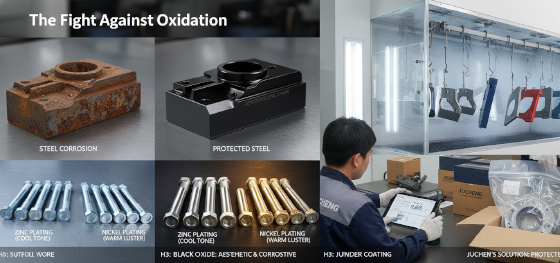
Applying the correct steel surface finish is not just an aesthetic choice; it is a critical engineering requirement. A high-performance part that fails due to corrosion is just as useless as one that fails due to poor tolerances. At Jucheng Precision, we view CNC Steel Machining as a two-stage process. The first stage is removing the metal; the second is protecting it. By integrating various finishing technologies into our production workflow, we ensure that your components arrive ready to survive the harshest industrial environments.
Choosing the right coating involves balancing cost, environmental exposure, and dimensional requirements. Some finishes add thickness, while others transform the metal at a molecular level. This guide details the primary methods we use to armor your steel parts against the elements while maintaining the precision you expect from JUCHENG.
Reality of Chemical Oxidation
Black Oxide Conversion Coating
Zinc and Nickel Plating
Powder Coating and Industrial Armor
Surface Roughness and Aesthetic Foundations
JUCHENG's Integrated Finishing Services
Reality of Chemical Oxidation
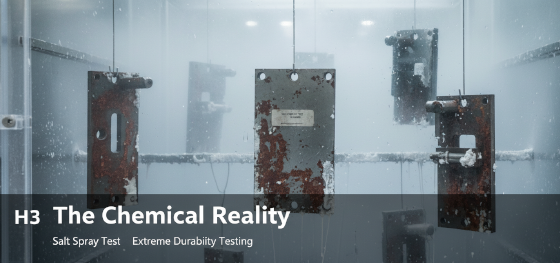
To protect steel, you must understand why it rusts. Iron atoms in steel have a natural tendency to lose electrons to oxygen molecules in the presence of water or moisture. This chemical reaction creates ferric oxide. Unlike the oxide layer on aluminum or titanium—which acts as a protective shield—iron oxide is porous and expansive. It flakes away, exposing fresh metal to further attack until the entire structure is compromised.
Manufacturing engineers measure the effectiveness of a finish through Salt Spray Testing (ASTM B117). Parts are placed in a chamber filled with a concentrated salt mist, and we count the hours until the first sign of "red rust" appears. Raw steel usually lasts less than one hour. A good finish can push that number to five hundred or even a thousand hours. At Jucheng Precision, we use these metrics to advise our clients on whether a cheap black oxide finish is sufficient or if a robust zinc-nickel alloy plating is a technical necessity for their specific climate.
Black Oxide Conversion Coating
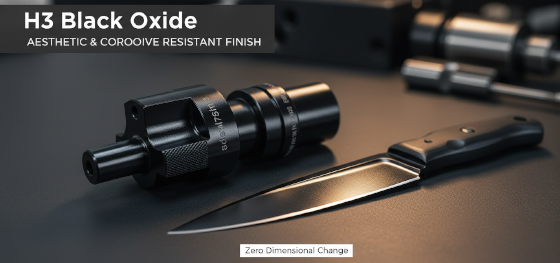
Precision is the primary reason engineers choose black oxide. Unlike paint or plating, which adds physical thickness to the part, black oxide is a conversion coating. It is a chemical reaction that transforms the top layer of the iron into magnetite ($Fe_3O_4$). The dimensional change is virtually zero—usually measured in millionths of an inch. This makes it the undisputed choice for precision gauges, tool holders, and internal machine components with ultra-tight tolerances of +/- 0.005mm.
Functionally, black oxide provides a matte black appearance that reduces light reflection, which is useful in optical systems. However, its corrosion resistance is limited. The coating itself is porous and must be "sealed" with a supplementary oil or wax to provide real protection. If the oil is wiped away, the steel becomes vulnerable again. JUCHENG recommends black oxide for indoor applications where parts are frequently handled or lubricated, but never for outdoor or marine environments.
Zinc and Nickel Plating
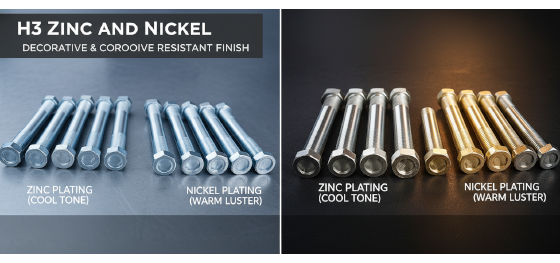
Electroplating involves depositing a thin layer of another metal onto the steel surface via an electric current. This creates a physical barrier that is far more durable than a conversion coating. The two most common options are Zinc and Nickel.
Zinc Plating is the industrial standard for fasteners and automotive brackets. It provides "sacrificial protection." Because zinc is more reactive than iron, it will corrode first, shielding the steel underneath even if the coating is scratched. We can offer clear (silver) or yellow (gold-like) chromate seals to enhance the look and durability. Nickel Plating, conversely, is for high-wear and high-visibility parts. It is much harder than zinc and offers a warmer, yellowish-silver luster. Electroless Nickel is a specialized version of this finish that provides a perfectly uniform thickness across the entire part, including inside deep holes and complex internal channels, which is impossible with standard electroplating.
Powder Coating and Industrial Armor

For the ultimate in durability and color flexibility, powder coating is the heavy artillery. This process involves electrostatically applying a dry plastic powder to the steel and then curing it in a high-temperature oven. The powder melts and flows into a continuous, tough-as-nails shell. It is significantly thicker than plating, typically ranging from 0.05mm to 0.15mm.
Powder coating is ideal for external housings, frames, and components exposed to gravel, debris, or harsh cleaning chemicals. It provides excellent UV resistance and can hide minor surface imperfections left by the machining process. Because it adds significant thickness, JUCHENG engineers always advise our clients to account for this in their CAD models. We often mask off critical bearing bores or threaded holes to ensure the coating doesn't interfere with the final assembly tolerances. If your part needs to survive ten years in the sun and rain, powder coating is your best investment.
Surface Roughness and Aesthetic Foundations

A great finish starts with a great substrate. No coating can hide a poor machining job. If the tool leaves deep chatter marks or "tears" in the steel, the plating will only highlight those defects. The quality of a steel surface finish is inextricably linked to the initial Surface Roughness ($Ra$).
At Jucheng Precision, we optimize our tool paths to deliver a consistent $Ra$ 1.6 or better directly off the machine. For decorative nickel or chrome plating, we may perform secondary hand-polishing or bead blasting to achieve a uniform texture. Bead blasting creates a beautiful "frosted" or matte appearance that is highly popular in consumer electronics and medical enclosures. By controlling the roughness of the steel before the finish is applied, we guarantee a professional result that looks as good as it performs.
JUCHENG's Integrated Finishing Services

The biggest risk in steel manufacturing is the gap between vendors. If you buy machining from one shop and plating from another, who is responsible if the parts arrive with rust or out of tolerance? This "vendor finger-pointing" is a major source of project delays.
Jucheng Precision solves this by offering a complete, one-stop manufacturing ecosystem. We manage the entire chain: material procurement, 5-axis machining, heat treatment, and final surface finishing. When we ship your parts, they are cleaned, finished, inspected, and vacuum-sealed with rust-preventive desiccants. You receive a finished component that is ready to bolt onto your machine the moment you open the box. Don't leave your steel designs vulnerable to the elements. Let JUCHENG help you armor your engineering and deliver a product that stands the test of time. Contact us today to discuss the perfect finish for your steel project.
```

