


Imagine trying to cut a block of ice that has been frozen full of thousands of tiny, jagged needles. This is essentially what happens when you introduce glass fibers into a nylon matrix. In the field, glass-reinforced nylon is a structural titan. It replaces die-cast metals in intake manifolds, structural housings, and heavy-duty industrial brackets. But on the CNC machine bed, it is a material that behaves with a unique kind of violence. It doesn't just wear down tools; it grinds them into uselessness.
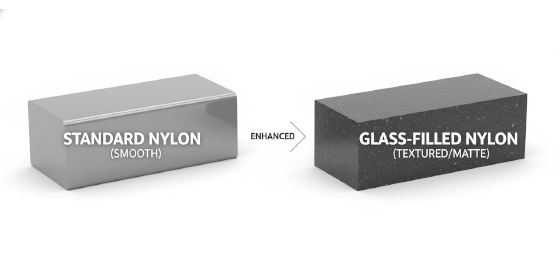
Success in nylon cnc machining changes entirely when you shift from unfilled polymers to reinforced composites. Standard nylon is gummy and soft. Glass-filled nylon—specifically the industry-standard GF30—is rigid, abrasive, and unforgiving. If you use standard speeds and feeds, you won't just ruin the part; you might destroy your spindle bearings with the fine, abrasive dust that the process generates. At Jucheng Precision, we have mastered the art of Machining Glass-Filled Nylon by treating it as a high-precision composite, utilizing specialized diamond-grade tooling and strict environmental controls to deliver parts that are as beautiful as they are strong.
For the engineer, specifying glass-filled nylon is a move toward maximum performance. For the manufacturer, it is a move toward extreme technical discipline. This guide explores the mechanical realities of working with GF30, the tooling secrets JUCHENG uses to combat abrasion, and the strategies we employ to eliminate "fiber bloom" for an aerospace-grade finish.
Decoding GF30: The Reinforced Giant
The Abrasive Challenge: Sanding Your Tools
Tooling Mastery: The Diamond Advantage
Managing Fiber Bloom: Achieving Smooth Surfaces
Safety First: Managing Abrasive Dust
JUCHENG's Precision Edge in GF Materials
Decoding GF30: The Reinforced Giant
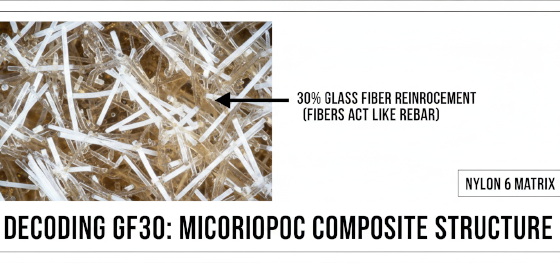
To understand the difficulty of this material, you must look at its microstructure. Glass-filled nylon is not a single material but a composite. In a typical GF30 grade, the nylon resin acts as a binder for 30% by weight of short-strand glass fibers. These fibers are essentially microscopic rods of silica. They are incredibly hard, brittle, and strong. When the polymer is molded or extruded, these fibers align along the flow lines, creating a grain structure that provides the plastic with metal-like rigidity and high heat-deflection temperatures.
This reinforcement solves nylon's biggest weakness: its flexibility. Unfilled nylon will creep and deform under a constant load. Glass-filled nylon stands its ground. However, this same strength makes the material "notch-sensitive." If a CNC tool leaves a microscopic tear or a rough edge during Machining Glass-Filled Nylon, that flaw can become a starting point for a crack. The fibers provide strength, but they also create thousands of potential failure points if the machining isn't surgically clean. At Jucheng Precision, we analyze the fiber orientation of the raw stock before we begin, ensuring our tool paths work with the material's grain, not against it, to maximize the structural integrity of the final component.
The Abrasive Challenge: Sanding Your Tools
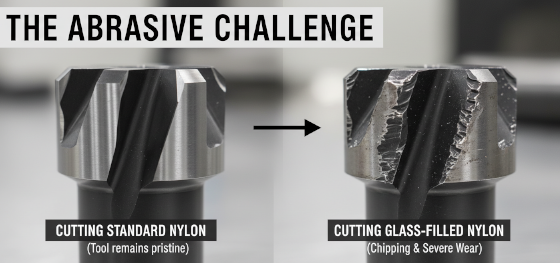
If you use a standard carbide end mill to cut GF30, you will notice something alarming within minutes. The tool stops cutting and starts rubbing. If you inspect the edge under a microscope, you will see that the razor-sharp corner has been rounded off. This is abrasive wear. Because the glass fibers are harder than the binder in many tool coatings, they effectively act like sandpaper, grinding away the cutting edge with every rotation.
This abrasion doesn't just dull the tool; it generates immense heat. In standard nylon cnc machining, heat is your enemy because it melts the plastic. In glass-filled machining, heat is your enemy because it accelerates tool degradation. Once the tool becomes dull, it no longer slices through the glass fibers. Instead, it begins to "yank" them out of the nylon matrix. This leaves the surface feeling like a rough wool sweater rather than a smooth engineered part. Managing this abrasive encounter requires a radical shift in tooling strategy that most general machine shops simply aren't equipped to handle. JUCHENG solves this through a heavy investment in exotic tool materials that can survive the "sandstorm" inside the machine enclosure.
Tooling Mastery: The Diamond Advantage

When we quote a project for Machining Glass-Filled Nylon, our clients sometimes ask why the tooling cost is higher than for standard nylon. The answer is Polycrystalline Diamond (PCD). For long production runs of GF30, standard carbide is a waste of time. We utilize PCD-tipped tools or specialized CVD diamond coatings. Diamond is the only material on Earth that is significantly harder than glass fibers. It allows us to maintain a razor-sharp edge for thousands of parts, where a carbide tool would fail after fifty.
The geometry of these tools is equally critical. We use high-positive rake angles and polished flutes. The goal is to slice the fibers instantly upon contact. If the tool "pushes" the fiber, the fiber will eventually snap or tear, leaving a pitted surface. By using diamond-hard edges and high-speed spindles, Jucheng Precision ensures that the fibers are sheared flush with the polymer surface. This leads to a finish that is structurally sound and aesthetically pleasing. While the initial investment in PCD tooling is higher, the ROI is found in the drastic reduction in scrap rates and the incredible surface consistency we provide for our automotive and aerospace clients.
Managing Fiber Bloom: Achieving Smooth Surfaces
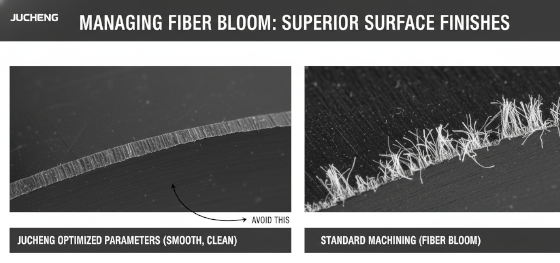
One of the most common aesthetic complaints with reinforced plastics is "fiber bloom." This occurs when the nylon resin is worn away or melted during machining, leaving the glass fibers exposed on the surface. It looks like a fine, white fuzz and feels like rough sandpaper. In medical or high-end consumer applications, this is a major defect. It can also cause issues with secondary processes like painting or ultrasonic welding, as the exposed glass interferes with the bond.
At Jucheng Precision, we eliminate fiber bloom through precise thermal management. We utilize high-pressure cold air guns and specialized mist coolants to keep the material well below its glass transition temperature. If the nylon stays cool, it remains rigid enough to hold the glass fibers in place while the tool shears them. We also employ a "dual-pass" strategy: a heavy roughing pass to remove bulk material, followed by a very light, high-speed finishing pass with a brand-new tool. This ensures that any fibers disturbed during the roughing stage are cleanly trimmed away during the final pass. The result is a smooth, matte finish that hides the reinforcement and highlights the precision of the design.
Safety First: Managing Abrasive Dust

Machining reinforced plastics isn't just hard on tools; it's hard on the environment. The chips generated during Machining Glass-Filled Nylon are essentially glass-reinforced dust. This dust is a serious health hazard if inhaled and a mechanical hazard for the CNC machine itself. Glass fines are abrasive enough to grind through the seals of machine ways and can even lead to electrical shorts if they settle on circuit boards.
Jucheng Precision operates a facility designed for composite handling. Our CNC centers for glass-filled nylon are equipped with high-volume industrial dust extraction systems that pull the fines directly from the cutting zone. We also utilize a "wet-capture" method in many cases, using coolant to trap the glass dust in a filtration system. Our operators follow strict EHS protocols, including the use of specialized PPE, ensuring a safe working environment. This attention to detail protects our machines and our team, ensuring that our facility remains at 100% operational capacity to meet your production deadlines. We don't just care about the part; we care about the process that creates it.
JUCHENG's Precision Edge in GF Materials
The biggest hurdle in nylon cnc machining with glass reinforcement is dimensional instability caused by moisture. As we've mentioned in our other guides, nylon is hygroscopic. It drinks water. In GF30, the glass fibers don't absorb water, but the nylon binder does. This can lead to internal stresses where the expanding nylon pulls against the rigid glass fibers. Without expert control, this leads to warping that can't be fixed.
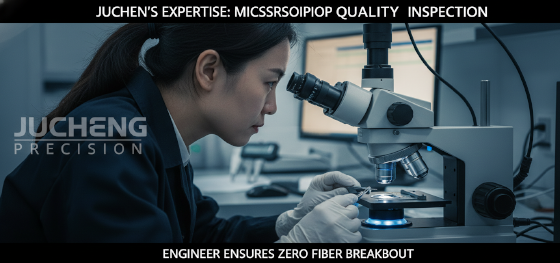
Jucheng Precision employs a unique "thermal stabilization" cycle for all our glass-filled nylon projects. We anneal the raw stock before machining to release extrusion stresses, and we perform a secondary stabilization after roughing. This ensures that the glass and the nylon have found their equilibrium before we perform the final precision cuts. Our QC team uses 40x magnification to inspect every edge, ensuring that your parts are free of delamination and fiber bloom. When you partner with JUCHENG, you are leveraging decades of experience in the world's most difficult engineered plastics. We provide the strength of glass with the precision of diamond. Contact our team today to receive a quote and a DFM review for your next reinforced nylon project.

