


Why are Olympic medals bronze, not brass? Both are beautiful, golden-hued metals. Both have been central to human civilization for millennia. Yet, one is chosen to represent the grit and endurance of a champion, while the other is more at home in a finely tuned instrument.
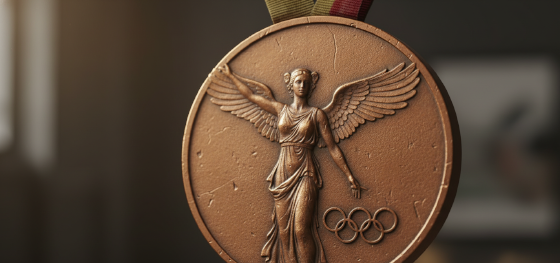
This is not an accident of history. It is a reflection of their very different personalities.
The question of brass vs bronze is a classic one for any designer or engineer working with "red metals." While they look similar, they are fundamentally different alloys with very different strengths. This guide will help you choose your champion.
content:
Two Cousins, Two Different Recipes
Round 1: The Test of Hardness and Wear
Round 2: The Art of the Cut - Machinability
Making the Right Choice
Two Cousins, Two Different Recipes
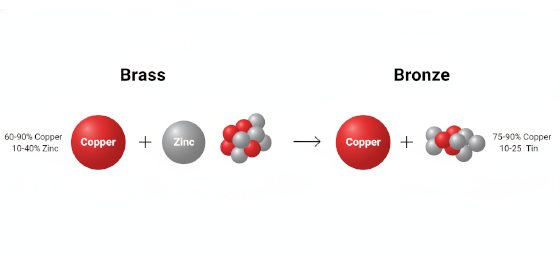
Brass and bronze are both copper-based alloys. This is why they share a similar reddish-golden color palette. But their secondary ingredient is completely different, and this changes everything.
Brass is an alloy of copper and zinc. The zinc makes the material more ductile and gives it a brighter, more yellow-gold color.
Bronze, in its most traditional form, is an alloy of copper and tin. Tin is a much harder element than zinc. It gives the alloy a duller, reddish-brown color and, most importantly, a very different set of mechanical properties. There are other bronzes (like aluminum bronze), but the classic tin-bronze is the benchmark.
Round 1: The Test of Hardness and Wear
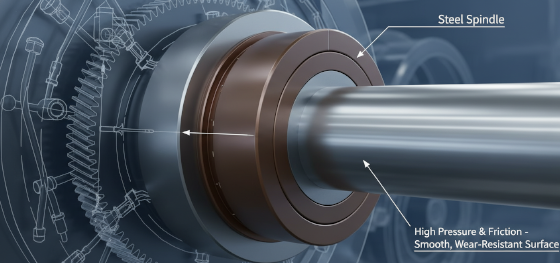
In a direct contest of durability, bronze is the clear winner. This is its superpower.
Bronze is significantly harder, stronger, and more resistant to wear than brass. It also has a low coefficient of friction when rubbing against other metals, especially steel. This combination makes it the ultimate "bearing" material.
When you need a part to withstand heavy loads and constant friction, you choose bronze. It is used to make bushings, bearings, and worm gear components in heavy machinery. It is tough and resilient. It has the personality of an endurance athlete. This is why it is used for medals—it symbolizes strength and longevity.
Winner: Bronze.
Round 2: The Art of the Cut - Machinability
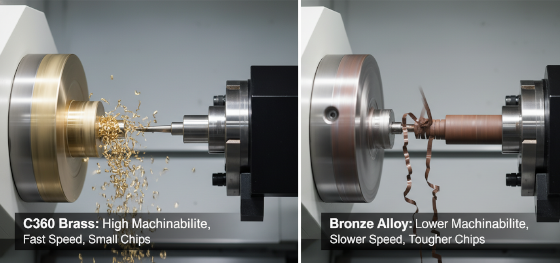
But that same hardness that makes bronze a champion of wear resistance also makes it a tougher opponent on the CNC machine. In the battle of machinability, brass has the clear advantage.
Specifically, "free-machining" brass alloys like C360 are a dream to cut. They allow for very high speeds and produce small, clean chips. This makes the brass cnc machining process fast, efficient, and cost-effective.
Bronze is much more difficult. It is more abrasive on cutting tools. It requires slower speeds and more careful process control. Machining a complex bronze part will take longer and therefore cost more than an identical part made from free-machining brass.
Winner: Brass.
Making the Right Choice
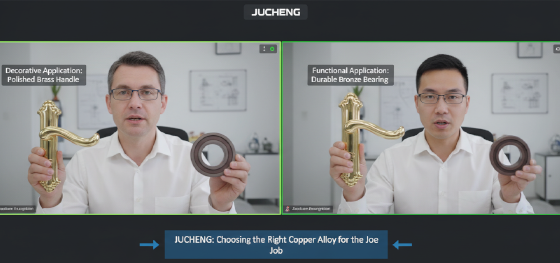
The choice in the brass vs bronze showdown is a very clear one, based entirely on the part's job.
| Factor | Brass (e.g., C360) | Bronze (e.g., C932) |
|---|---|---|
| Superpower | Excellent Machinability | Excellent Wear Resistance |
| Hardness & Durability | Good | Superior |
| Color | Bright Yellow-Gold | Reddish-Brown |
| Best For | Fittings, Valves, Decorative Parts | Bushings, Bearings, Marine Hardware |
You choose Bronze when your part's primary function is to survive friction and wear. If it is a bushing, a bearing, or a gear that will be in constant moving contact with another part, bronze is the superior engineering choice.
You choose Brass when your part needs to be produced efficiently at high volumes, or when its primary function is aesthetic. For most standard fittings, valves, and decorative hardware, the excellent machinability and beautiful finish of brass make it the smarter, more cost-effective choice.
A good manufacturing partner understands this critical distinction. At JUCHENG, we have the expertise to machine both of these classic alloys. We can help you analyze the specific demands of your project and choose the red metal champion that is right for your fight.

