


Your product is a success in your home market. Now it is time to go global. You prepare your first shipment to Europe or California. And it gets rejected at the border.
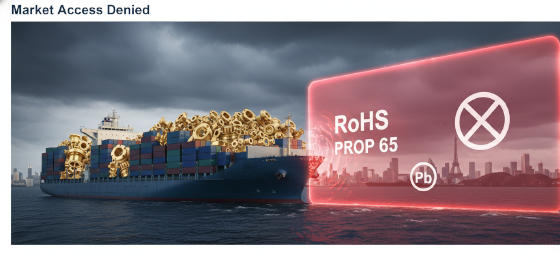
The reason? Your beautiful, functional brass components contain a tiny amount of lead. You have just run into a wall of global regulations like RoHS and Proposition 65.
This is a nightmare scenario for any growing business. To compete in the modern world, your product must be compliant. This is why understanding and Machining Lead Free Brass is no longer an option. It is a necessity.
The Problem: Lead's Toxic Legacy
The Solution: A New Generation of Alloys
A Machinist's New Challenge
Your Partner in a Compliant Future
The Problem: Lead's Toxic Legacy
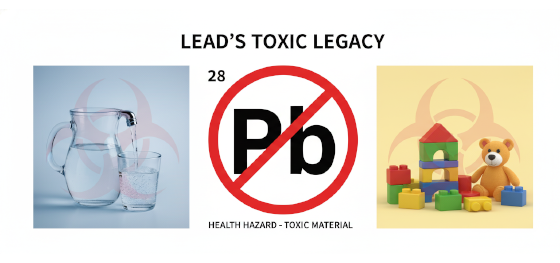
For decades, the king of machinability was C360 Free-Machining Brass. Its secret ingredient was a small amount of lead. The lead made it incredibly easy to cut.
But lead is a toxic heavy metal. There is a growing global movement to remove it from all consumer products. Regulations like RoHS (Restriction of Hazardous Substances) in Europe and the Safe Drinking Water Act and Proposition 65 in the USA, strictly limit or ban the use of lead.
This is especially critical for any part that comes into contact with drinking water, like a faucet or a valve. It is also a major concern for any electronic product sold in Europe. Using a leaded brass alloy is no longer a viable option for a global product.
The Solution: A New Generation of Alloys
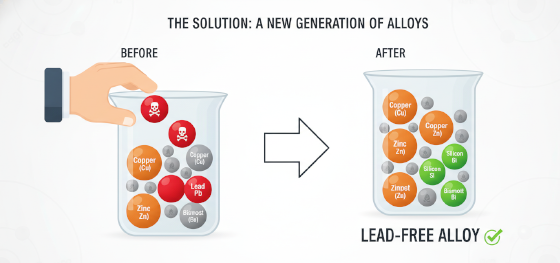
To solve this, material scientists have created a new generation of "lead-free" or "low-lead" brass alloys.
These alloys are a marvel of modern metallurgy. They remove the toxic lead and replace it with other elements to maintain good machinability. The most common replacements are silicon and bismuth.
These "eco-brasses" are designed to meet the strictest health and environmental standards. They provide the strength, corrosion resistance, and beautiful appearance of traditional brass, but in a compliant, future-proof package. When you perform brass cnc machining with these alloys, you are creating a part that is ready for the global market.
A Machinist's New Challenge
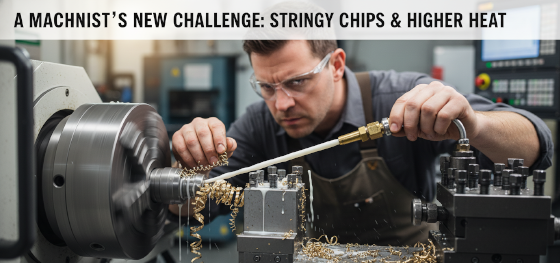
But there is a trade-off. While these new alloys are a huge step forward for safety and compliance, they present a new challenge for manufacturers.
The hard truth is that nothing machines quite as well as lead. The new silicon and bismuth-based alloys are "gummier" and more abrasive than the old C360.
The process of Machining Lead Free Brass requires a different strategy. The chips tend to be stringier and less broken. The material can be tougher on cutting tools. A machinist cannot simply use the same speeds and feeds they used for C360. They must adapt.
This often means using different tool geometries, adjusting cutting parameters, and having a more rigorous process to manage chips and heat. It is a more demanding process that requires a higher level of skill and experience.
Your Partner in a Compliant Future
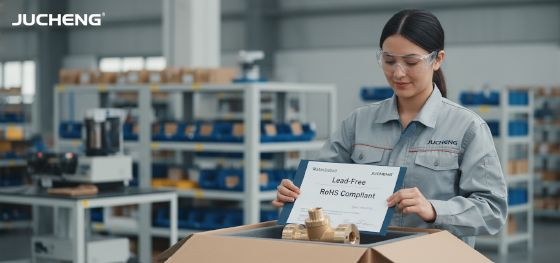
Navigating the complex world of global material regulations and the new challenges of machining lead-free alloys can be daunting.
This is why your choice of manufacturing partner is more critical than ever. You need a partner who is not just a good machinist, but also a student of global compliance.
At JUCHENG, we are experts in this field. We have the supply chain to source a wide variety of certified, RoHS-compliant lead-free brass alloys. We have the deep machining expertise to handle these tougher, gummier materials efficiently.
We can provide full material certification with your parts, giving you the documentation you need to prove your product's compliance to any regulatory body in the world. This is your passport to the global market. It is your guarantee that your product is not just well-made, but also safe, responsible, and ready for the future.

