


Your design needs to conduct electricity. The higher the conductivity, the better the performance. So, the choice is simple, right? You choose the most conductive metal you can afford. You choose pure copper.

But what if that choice makes your part three times more expensive to manufacture? What if its softness leads to a high scrap rate during production?
This is the engineering dilemma at the heart of the brass vs copper debate. It is a classic battle between pure, uncompromising performance and smart, practical, cost-effective engineering.
Meet the Champion of Purity: Copper
Meet the Champion of Practicality: Brass
The Head-to-Head Battle: A Tale of the Tape
Making the Right Call
Meet the Champion of Purity: Copper
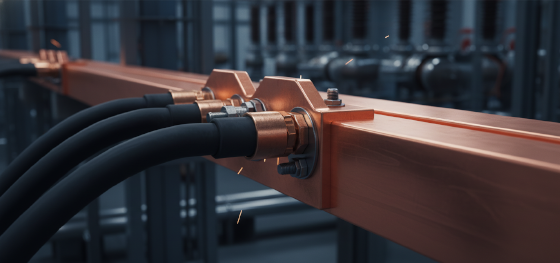
Pure copper is the champion of conductivity. After silver, it is the most electrically and thermally conductive element on Earth. Its ability to move electrons and heat with minimal resistance is its undisputed superpower.
This is why it is the backbone of the entire electrical world. From the giant busbars in a power station to the tiny traces on a circuit board, copper is the material of choice when efficiency is paramount.
But this purity comes with a cost. Pure copper is very soft and "gummy." It is notoriously difficult to machine. It sticks to cutting tools, creates long, stringy chips, and requires very specific strategies to achieve a good surface finish. This difficulty makes it slow and expensive to manufacture.
Meet the Champion of Practicality: Brass
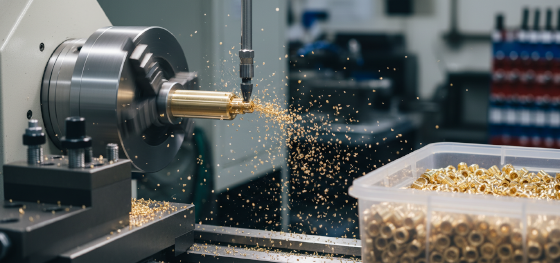
Brass is the champion of practicality. It is an alloy of copper and zinc. By sacrificing some of copper's purity, it gains a huge advantage in another area: machinability.
Specifically, a free-machining alloy like C360 brass is a dream to cut. The addition of zinc and a small amount of lead makes the material much harder and causes the chips to break cleanly.
This means a brass cnc machining process can be run at incredibly high speeds. The cycle time is much lower. The tool life is much longer. The final cost per part is dramatically reduced. It is a material designed for efficient, large-scale production. The trade-off? Its electrical conductivity is only about 26% that of pure copper.
The Head-to-Head Battle: A Tale of the Tape
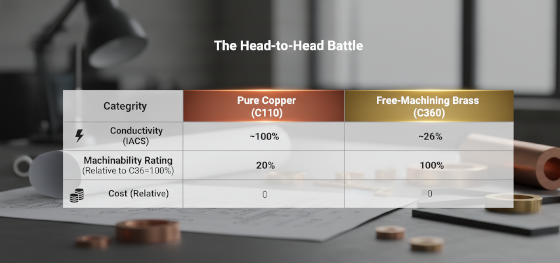
Let's put the two champions side-by-side in a direct comparison.
| Factor | Pure Copper (C110) | Free-Machining Brass (C360) |
|---|---|---|
| Superpower | Ultimate Conductivity | Ultimate Machinability |
| Conductivity (IACS) | ~100% | ~26% |
| Machinability Rating | 20% (Poor) | 100% (Excellent) |
| Strength & Hardness | Poor | Good |
| Cost (Machined Part) | High | Low |
Making the Right Call

The choice in the brass vs copper battle is a classic engineering trade-off. It is about asking: "How much conductivity do I really need?"
If your application is at the absolute peak of performance—a high-end audio connector where every percentage of signal purity matters, or a massive busbar carrying thousands of amps where every percentage of resistance creates a huge amount of waste heat—then pure copper is the only answer. You must pay the higher manufacturing cost to get that ultimate performance.
But for the vast majority of electrical and thermal components, the answer is different. For most standard electrical pins, connectors, and fittings, the 26% conductivity of brass is more than enough to do the job safely and efficiently.
In these cases, choosing brass is the much smarter engineering decision. You get a part that is strong enough, conductive enough, and dramatically cheaper and faster to produce in high volumes.
A good manufacturing partner can help you make this critical calculation. At JUCHENG, we have deep expertise in machining both of these challenging metals. We can analyze your design and performance requirements and provide a clear, data-driven recommendation. We help you choose the champion that is right for your specific fight.

