


In the high-performance material hierarchy, there is a tier that sits above standard engineering plastics and even challenges the dominance of lightweight alloys like titanium and magnesium. This is the world of carbon-reinforced polyamides, specifically the variant known in the machine shop as "Black Gold"—Carbon Fiber PEEK. When you take the already legendary Polyetheretherketone and infuse it with thirty percent short-strand carbon fibers, you create a composite that offers a strength-to-weight ratio that seems to defy the laws of polymer science. It is the material of choice for the leading edges of aerospace wings, the high-stress internals of Formula 1 engines, and the structural nodes of satellite frames.
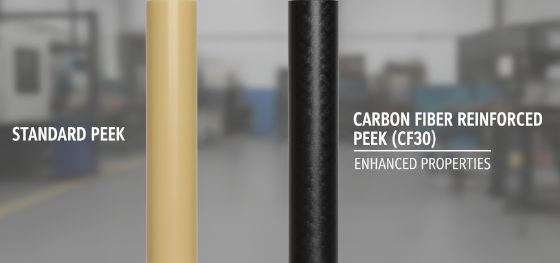
However, the very properties that make CF30 PEEK an engineering masterpiece make it a manufacturing nightmare. This is arguably the most abrasive material in the entire plastic inventory. Success in Carbon Fiber PEEK Machining requires a radical departure from standard plastic cutting techniques. You are no longer just cutting a polymer; you are essentially cutting a block of resin filled with millions of microscopic, razor-sharp ceramic-like needles. At Jucheng Precision, we have built our reputation on mastering these "impossible" composites. Through a combination of diamond-grade tooling and advanced peek cnc machining strategies, we deliver components that maintain their structural integrity while meeting the micron-level tolerances demanded by the world’s most elite industries.
For the engineer, specifying Carbon Fiber PEEK is an aggressive move toward maximum performance. For the manufacturer, it is a test of technical discipline. This guide dives deep into the structural anatomy of CF-PEEK, the extreme abrasive challenges it poses to conventional tooling, and the sophisticated methods JUCHENG uses to prevent fiber pull-out and surface delamination. Understanding these variables is the difference between a part that fails under load and a part that sets a new industry benchmark.
Structural Anatomy: The Science of Reinforcement
The Abrasive Challenge: Sanding Your Tooling
PCD Revolution: Why Diamond is Mandatory
Surface Integrity: Solving Fiber Pull-out
Thermal Management in Composite Cutting
JUCHENG’s F1 and Aerospace Standards
Structural Anatomy: The Science of Reinforcement
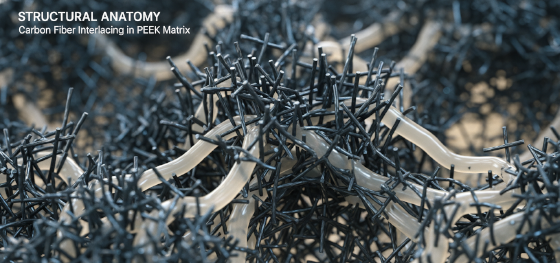
To master the machining of this material, you must first understand its internal architecture. Standard PEEK derives its strength from its semi-crystalline matrix. In Carbon Fiber PEEK (typically GF30), that matrix is reinforced with short-strand carbon fibers that comprise 30% of the total weight. These fibers act as the "rebar" in the concrete of the polymer, absorbing tensile and compressive loads and preventing the polymer chains from sliding past each other. This results in a material with nearly double the tensile strength of unfilled PEEK and a significantly higher flexural modulus.
However, this reinforcement introduces "anisotropy." During the extrusion or injection molding of the raw stock, the carbon fibers align themselves in the direction of the material flow. This means the material is significantly stronger along the grain than against it. At Jucheng Precision, our Carbon Fiber PEEK Machining process begins with a careful analysis of this grain direction. If you machine a high-stress bracket without considering the fiber orientation, the part can fail at a fraction of its intended load. We align our tool paths to respect the structural anatomy of the composite, ensuring that the finished part exploits the maximum strength of the carbon reinforcement.
The Abrasive Challenge: Sanding Your Tooling
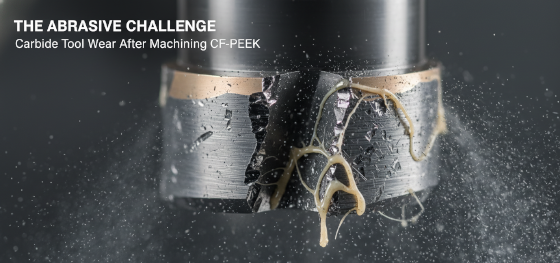
The most immediate problem when cutting CF-PEEK is the sheer violence it inflicts on the cutting tool. Carbon fibers are essentially ceramics. They are much harder than the cobalt binder used in standard tungsten carbide tools. When a CNC tool engages a CF-PEEK billet, it doesn't just cut; it is subjected to a relentless sanding action. Within minutes, a standard carbide tool that would last hours in aluminum will be rounded off, losing its sharp edge and beginning to "push" the material rather than shearing it.
Once a tool becomes dull, the machining process degrades rapidly. The dull edge creates massive amounts of friction, which generates heat. Because PEEK is a thermal insulator, that heat cannot escape through the part. It concentrates at the tool tip, causing the PEEK matrix to soften and the carbon fibers to break unevenly. This leads to a poor surface finish and dimensional inaccuracy. Jucheng Precision manages this abrasive encounter by utilizing specialized tool life management software. We track the distance traveled by every tool and perform proactive changes before the edge degrades. We understand that in high-value composite machining, the cost of a new tool is nothing compared to the cost of a scrapped aerospace housing.
PCD Revolution: Why Diamond is Mandatory
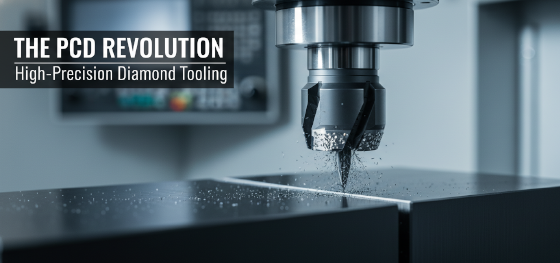
To solve the abrasive wear problem, Jucheng Precision has invested heavily in the "Diamond Revolution." For any significant production run of Carbon Fiber PEEK, standard carbide is obsolete. We utilize Polycrystalline Diamond (PCD) or CVD diamond-coated tooling. Diamond is the only material on the planet that is significantly harder than carbon fiber. A PCD-tipped end mill can maintain a razor-sharp edge for fifty times longer than carbide when cutting CF-PEEK.
The sharp edge of a PCD tool is the key to Carbon Fiber PEEK Machining success. It allows us to "slice" through the carbon fibers instantly, creating a crisp, clean cut. This reduces the cutting force required and minimizes the vibration that causes surface defects. By maintaining tool sharpness, we ensure that the PEEK matrix is not overheated and that the carbon fibers are sheared flush with the surface. While the initial investment in diamond tooling is high, it is the only way to achieve the consistent quality and mirror-like finishes required for Formula 1 suspension components and surgical robotics. JUCHENG’s mastery of these exotic tools is what allows us to offer competitive lead times on materials that other shops refuse to quote.
Surface Integrity: Solving Fiber Pull-out
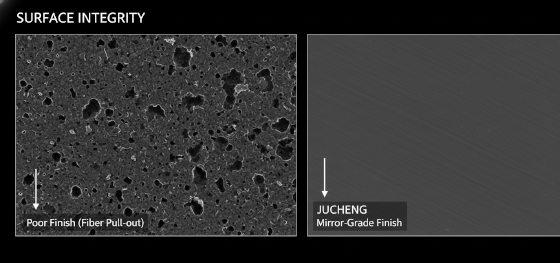
One of the most difficult quality issues to manage in composite machining is "Fiber Pull-out." This occurs when the cutting tool is not sharp enough or the feed rate is incorrect, causing the tool to yank the carbon fibers out of the PEEK matrix rather than cutting them. This leaves microscopic pits on the surface of the part, which look like tiny black craters. In aerospace applications, these pits are more than an aesthetic flaw; they are potential "stress risers" where a crack can begin under high-frequency vibration.
At Jucheng Precision, we eliminate fiber pull-out through a "High-Speed, Low-Pressure" strategy. We utilize high spindle speeds combined with very light finishing passes. We want the tool to move through the material so quickly that the carbon fibers don't have time to react or deflect. We also pay close attention to the tool geometry, using high-positive rake angles that direct the cutting force into the part rather than away from it. This prevents "delamination," where the layers of the composite begin to separate. Our quality control team uses 40x magnification microscopes to verify that every machined surface is smooth and that the fibers are perfectly integrated into the resin, ensuring the part meets the structural requirements of its flight-certified design.
Thermal Management in Composite Cutting
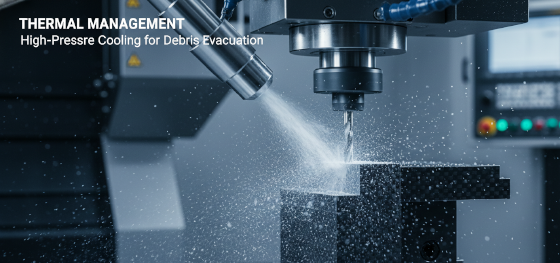
PEEK is famous for its heat resistance, but during Carbon Fiber PEEK Machining, the friction generated is so intense that even PEEK can reach its limits. The carbon fibers generate massive amounts of localized thermal energy at the shear zone. If this heat isn't removed, the PEEK matrix will begin to soften (reach its Glass Transition temperature), leading to "smearing" where the plastic flows over the fibers. This ruins the dimensional accuracy and the surface finish of the part.
We solve this through a "Dry-Cool" approach. While liquid coolants can be used, they often create a messy slurry when mixed with fine carbon dust, which can clog the machine's filtration system. Instead, Jucheng Precision utilizes high-pressure cold air guns directed exactly at the tool-workpiece interface. This air blast serves a dual purpose: it removes the heat from the cutting zone and physically blows the abrasive carbon dust away from the part before it can be re-cut. Re-cutting carbon dust is a major cause of secondary tool wear. By keeping the cutting zone clear and cold, we maintain the crystalline stability of the PEEK, allowing us to hold tolerances of +/- 0.015mm on large structural components.
JUCHENG’s F1 and Aerospace Standards
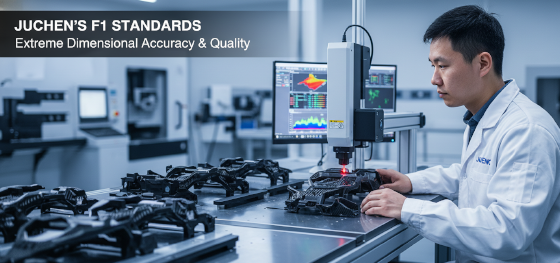
When you outsource your high-end composite machining to Jucheng Precision, you are accessing a facility that operates under a "Zero-Failure" philosophy. We understand that Carbon Fiber PEEK is often used for the most critical components in a system. Our facility is ISO 9001 and ISO 13485 certified, and we follow AS9100-level documentation protocols for our aerospace clients.
| Property | Unfilled PEEK | Carbon Fiber PEEK (CF30) |
|---|---|---|
| Tensile Strength | ~100 MPa | ~250+ MPa |
| Flexural Modulus | ~4 GPa | ~18 GPa (Metal-like) |
| Machinability | Excellent | Difficult / Highly Abrasive |
| Tooling Required | Carbide | PCD / Diamond Mandatory |
We don't just "cut to the print." We perform a comprehensive DFM review for every order, suggesting geometry changes that can reduce tool wear and improve part strength. We provide full material traceability and coordinate measuring machine (CMM) inspection reports with every batch, ensuring that the "Black Gold" components you receive are dimensionally perfect and structurally sound. Whether you are building a revolutionary heart pump or a next-generation drone chassis, Jucheng Precision has the technical rigor and the diamond-grade capability to bring your composite designs to life. Contact our engineering team today for a technical consultation on your next Carbon Fiber PEEK Machining project.

