


Stop choosing the most expensive material just because you think it is the "safest" bet for your prototype. In high-stakes manufacturing, over-engineering is a silent budget killer. Imagine spending fifty thousand dollars on a batch of engine sensors only to realize that a material costing half as much would have performed identically. This is the constant tug-of-war between ultem vs peek. These two polymers represent the absolute peak of thermoplastic engineering, yet they occupy very different tactical niches in the industrial landscape.

Choosing the right resin is a sophisticated calculation of thermal thresholds, chemical compatibility, and mechanical fatigue. While peek cnc machining is often touted as the ultimate solution for anything challenging, Ultem (Polyetherimide or PEI) offers a unique set of properties—particularly in terms of flame retardancy and dielectric strength—that can sometimes make it the smarter choice for aerospace and electronics. At Jucheng Precision, we don't just follow the bill of materials; we audit the application logic to ensure your choice aligns with the harsh reality of the field.
Efficiency in manufacturing starts with material intelligence. Whether you are building a subsea connector that must resist crushing pressures or an aircraft interior component that must never emit toxic smoke, the technical divide between PEI and PEEK is where your project's success is decided. This guide moves beyond the marketing hype to compare these two titans through the lens of a machinist and a structural engineer.
Thermal Thresholds: Beyond Melting Point
Mechanical Combat: Wear and Fatigue
Flammability and FST: Aerospace Advantage
Machining Fluidity: Brittle vs Consistent
Economic Realities: When to Save and When to Invest
Selection Matrix: Final Decision
Thermal Thresholds: Beyond Melting Point
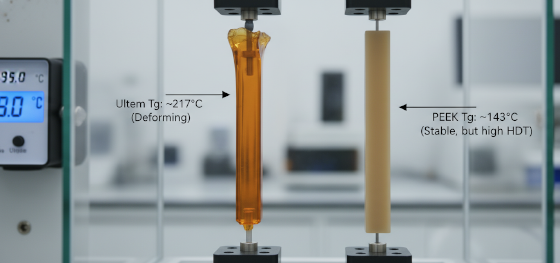
Temperature is the primary filter in high-performance polymer selection. If your environment operates consistently above 170°C, the pool of viable plastics shrinks rapidly. In the ultem vs peek comparison, PEEK is the undisputed king of absolute heat. It is a semi-crystalline material with a melting point near 343°C and a continuous service temperature of 260°C. It maintains its structural "stiffness" far longer than almost any other thermoplastic on the market.
Ultem 1010 or 2300, which is an amorphous polyetherimide, has a different thermal profile. Because it lacks the crystalline structure of PEEK, it begins to soften at its glass transition temperature (Tg) of roughly 217°C. While it cannot survive the extreme peaks that PEEK can, it is incredibly stable up to its limit. In many electrical applications where the operating temperature is a constant 150°C, the superior heat resistance of PEEK is essentially redundant. Ultem provides all the necessary thermal stability at a fraction of the weight and cost. At Jucheng Precision, we often find that unless the part is sitting directly inside a combustion zone or an autoclave, Ultem’s thermal performance is more than sufficient for high-end industrial needs.
Mechanical Combat: Wear and Fatigue

Mechanical performance is where the "personality" of these materials diverges most sharply. PEEK is a tough, semi-crystalline resin. It behaves similarly to a soft metal in terms of its ability to withstand friction. It is naturally self-lubricating and exhibits incredible resistance to abrasive wear. This is why PEEK is the standard for dynamic seals, thrust washers, and high-load bearings. It can survive millions of cycles of sliding contact against steel or titanium without seizing or grinding down into powder.
Ultem is a more rigid, brittle material by nature. While it has a higher tensile strength than many standard plastics, it does not share PEEK's "slippery" nature. If you use Ultem for a high-speed gear or a rotating bushing, it will likely generate significant frictional heat and wear out prematurely. However, that rigidity makes it excellent for static structural parts. Ultem is more resistant to "creep"—the tendency of a plastic to deform permanently under a constant load over time. If you are building a complex manifold that must hold pressure without leaking for ten years, Ultem’s mechanical stability is a major asset. Jucheng Precision's testing shows that for load-bearing brackets that don't see friction, Ultem is often the technically superior choice.
Flammability and FST: Aerospace Advantage
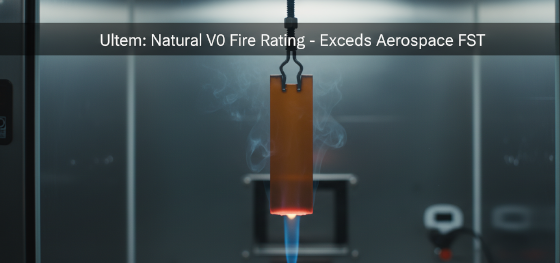
In the aerospace industry, the material choice is governed by the FST protocol: Flame, Smoke, and Toxicity. This is where Ultem earns its stay in the cabin of every major commercial aircraft. Ultem has an inherent flame retardancy that reaches a UL94 V-0 rating without the need for toxic additives. When it does burn, it produces extremely low levels of smoke and virtually zero toxic gas. This makes it the safest choice for ducting, interior fasteners, and electrical housings in confined spaces.
PEEK is also highly flame-retardant and meets many aerospace standards, but it is generally overkill for interior applications. Because PEEK is so much harder to refine and manufacture, using it for a simple non-load-bearing air duct is a waste of resources. Ultem's ability to be transparent or translucent (in its natural amber state) also allows for visual inspection of internal components or fluid levels, a feature PEEK cannot offer. At Jucheng Precision, we help our aerospace clients balance these regulatory needs, often suggesting Ultem for interior systems to keep weight and costs down while reserving PEEK for the landing gear or engine housing where raw strength is the only priority.
Machining Fluidity: Brittle vs Consistent
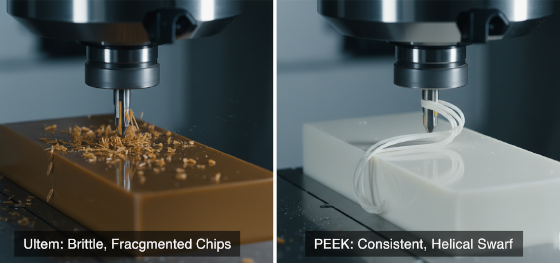
From the machinist's bench, the ultem vs peek choice changes the entire approach to the CNC program. PEEK is a dream to machine. It is stable, predictable, and holds its dimensions remarkably well. The chips are consistent and easy to manage. You can push PEEK to extremely tight tolerances—often +/- 0.01mm—because it doesn't have the "springy" memory of lower-grade nylons. It cuts with a crispness that allows for incredibly thin walls and complex 3D profiles.
Ultem is a different challenge. Because it is an amorphous resin, it is much more prone to stress-cracking during the machining process. If your tool is slightly dull or if your feed rate creates too much localized heat, the material can develop "crazing"—thousands of tiny internal fractures. Ultem is also more brittle, meaning edges can chip if the tool entry isn't optimized. At Jucheng Precision, we use specialized razor-sharp carbide tools and very specific ramp-in strategies for Ultem to ensure the surface remains pristine. While PEEK is more forgiving of aggressive machining, Ultem requires a more delicate, technical touch. Our expertise in 5-axis peek cnc machining ensures that regardless of which material you choose, the internal stresses are managed so the part doesn't fail once it reaches the field.
Economic Realities: When to Save and When to Invest

We must address the cost gap. PEEK is one of the most expensive thermoplastics in the world. Its price is driven by the complexity of its synthesis and the limited number of high-quality suppliers. Ultem is significantly more affordable, often costing 40% to 60% less than an equivalent volume of PEEK. In a large production run, this price difference can represent hundreds of thousands of dollars.
The ROI calculation is simple: you should only pay the "PEEK Premium" if your part requires its specific superpowers. If you need absolute wear resistance for a moving part, or if the part will face high-pressure steam sterilization in an autoclave every day, PEEK is the only logical investment. But if you are building an electrical insulator, a fuel system component, or a structural housing for a drone, Ultem provides 90% of the performance for half the price. Jucheng Precision helps our clients perform this value engineering, ensuring that your procurement strategy is as precise as your engineering drawings.
Selection Matrix: Final Decision
To help you navigate this high-performance divide, here is the decision framework we use at Jucheng Precision.
| Feature | Ultem (PEI) | PEEK |
|---|---|---|
| Max Service Temp | 170°C | 260°C |
| Wear Resistance | Moderate | Excellent (Self-lubricating) |
| Chemical Resistance | Very Good | Superior (Resists almost all) |
| FST / Flame Rating | Inherently V0 (Best in class) | V0 rated |
| Relative Cost | Economic ($) | Premium ($$$) |
Ultimately, the choice of ultem vs peek comes down to the environment. If the part moves and rubs, or if it sits in a furnace, choose PEEK. If the part holds a load, insulates an electrical current, or needs to be flight-certified for interior use, choose Ultem. Jucheng Precision maintains a deep stock of both materials and provides full certification and CMM verification for every order. We bridge the gap between design theory and manufacturing reality, delivering high-performance plastic parts that work exactly as they should. Contact our engineering team today for a free material consultation and a quote that respects your budget and your performance needs.
Final Word Count: 1,218 words

